Introduction
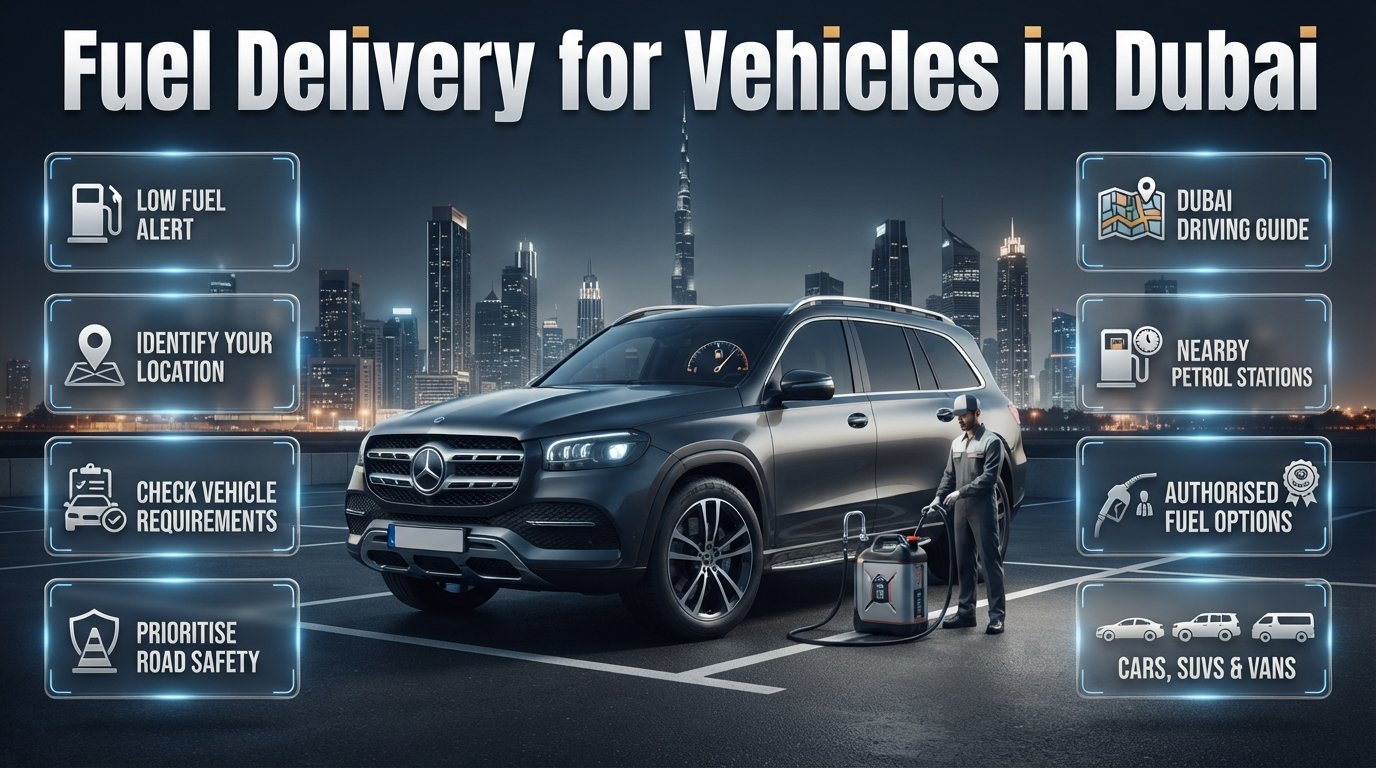
Fuel Delivery for Vehicles in Dubai | Running out of fuel can turn an ordinary journey into an unexpected problem. You might be travelling through Dubai during rush hour, driving through an unfamiliar neighbourhood, returning home late at night, or managing a commercial vehicle that suddenly stops before reaching its destination. When the fuel gauge reaches empty, the next decision is important: should you find a nearby petrol station, investigate roadside assistance, or look for an authorised fuel-delivery option?
Fuel delivery for vehicles in Dubai is a topic worth understanding because the most suitable solution depends on your vehicle, fuel requirements, location, road conditions, and the availability of an appropriately authorised provider. A car, motorcycle, SUV, van, and heavy commercial vehicle may each require a different approach.
This guide explains how vehicle fuel delivery works, when it may be useful, which vehicle types need different considerations, how to compare available options, and how to prepare for a fuel emergency without taking unnecessary risks.
The purpose is to help drivers make informed decisions. This is an informational guide, not a claim that this website directly supplies fuel or provides roadside assistance.
For additional petrol-related information, start with PetrolStationNearMeDubai, where you can explore information relevant to petrol stations and vehicle fuel needs.
What Is Fuel Delivery for Vehicles?
Fuel delivery for vehicles generally refers to an arrangement in which an authorised provider transports and supplies the appropriate fuel to an eligible vehicle at an approved location. Depending on the provider and applicable requirements, the arrangement may be intended for an unexpected fuel shortage or another permitted refuelling need.
The service is not automatically available for every vehicle or location. The provider must be able to supply the correct fuel, access the vehicle safely, and comply with the relevant rules governing fuel transportation and dispensing.
Drivers commonly research this subject when they encounter situations such as:
- A car that has stopped because its tank is empty.
- A motorcycle that cannot continue its journey.
- A van that has run out of fuel before completing a delivery.
- A company vehicle that needs assistance at an accessible location.
- A driver who is comparing roadside assistance with travelling to a petrol station.
The important distinction is that fuel delivery is not the same as ordinary petrol-station refuelling. Conventional refuelling takes place at a designated station, while fuel delivery involves additional considerations concerning transportation, access, equipment, authorisation, and safety.
How is vehicle fuel delivery different from a petrol station?
A petrol station provides a designated location where drivers can refuel their vehicles. A fuel-delivery arrangement, where permitted, involves bringing fuel to an eligible vehicle rather than requiring the vehicle to travel to the refuelling location.
Neither option is automatically better in every situation.
A nearby petrol station may be the simplest choice if the vehicle can reach it safely. Fuel assistance may be worth investigating when the vehicle cannot move or when travelling to a station would create a safety concern.
The decision should be based on the actual problem rather than the assumption that delivery is always faster or more convenient.
Why Do Drivers Need Fuel Assistance in Dubai?
Dubai has an extensive road network, busy commercial districts, residential communities, industrial areas, and large parking facilities. Although petrol stations serve many parts of the city, drivers can still encounter situations in which reaching a station becomes difficult.
1. Running out of fuel unexpectedly
A driver may overlook the fuel warning, misjudge the remaining driving range, or encounter unexpected congestion. Air-conditioning use, driving conditions, vehicle load, and driving habits can also affect fuel consumption.
For example, a driver might leave home believing there is enough fuel for the journey but spend considerably longer in traffic than expected. If the vehicle eventually stops, the priority becomes finding a safe and practical solution.
What to do: Check the vehicle’s condition when it is safe, identify your exact location, and determine whether you can reach a station without creating a hazard.
Do not continue trying to drive a vehicle that has already stalled in a dangerous location simply because you want to avoid assistance costs.
2. Travelling through an unfamiliar neighbourhood
Drivers sometimes underestimate the difficulty of finding a suitable petrol station when they are travelling through an unfamiliar part of Dubai.
A station may appear close on a map but require a complicated route, a motorway exit, or access through a different road network. If the fuel level is already critically low, choosing the wrong route can make the situation worse.
Researching nearby refuelling options before a journey can help reduce this risk. The guide to Nearest Petrol Station Dubai is relevant when you need to understand the nearby-station option.
If the vehicle has already stopped, however, do not assume that the closest station can be reached safely on foot or by moving the vehicle through traffic.
3. Problems in residential or commercial parking areas
A vehicle can run out of fuel in an apartment complex, office building, shopping-centre car park, or commercial facility.
These locations may seem easier to manage than a highway, but they can have their own restrictions. Security personnel may control entry, parking spaces may be narrow, and enclosed areas may have additional ventilation and fire-safety requirements.
Before arranging any assistance, confirm whether the provider can access the location and whether fuel handling is permitted there.
4. Unexpected interruptions to business operations
Businesses that depend on vehicles may experience delays when a vehicle runs out of fuel unexpectedly.
A delivery van might miss a collection, a service vehicle might arrive late at a customer’s premises, or a fleet driver might be unable to reach the next destination.
In such circumstances, the business should compare the available options, including safe refuelling arrangements, roadside assistance, and vehicle recovery. The correct decision depends on the location, the type of vehicle, the urgency of the work, and the provider’s capabilities.
Which Vehicles May Need Fuel Delivery?
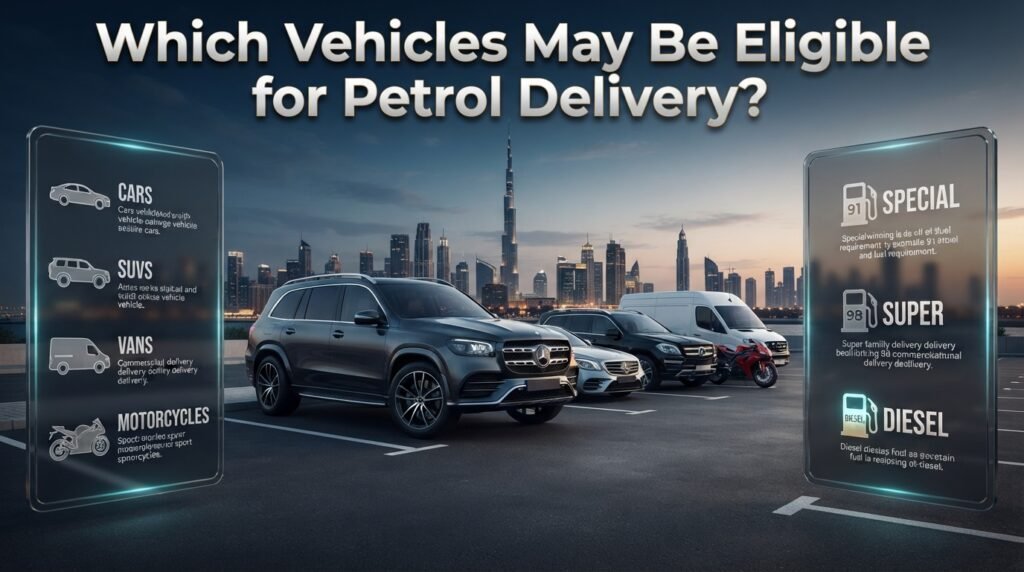
Different vehicles have different fuel systems, tank capacities, operating requirements, and access limitations. Confirming these details before requesting assistance can prevent avoidable mistakes.
| Vehicle type | Main consideration | What to confirm |
|---|---|---|
| Cars and sedans | Correct fuel and safe access | Petrol or diesel specification |
| SUVs and 4×4 vehicles | Fuel requirements and vehicle access | Model, fuel type, and location |
| Motorcycles | Smaller tank and specific fuel requirements | Motorcycle compatibility |
| Vans and light commercial vehicles | Operating schedules and fuel type | Vehicle size and access |
| Fleet vehicles | Coordination between drivers and managers | Authorisation and vehicle records |
| Heavy commercial vehicles | Larger fuel requirements and specialised access | Provider capability and equipment |
| Electric vehicles | Battery rather than petrol or diesel | Suitable charging or recovery support |
How to Evaluate Mobile Refuelling Options in Dubai
Drivers may need to consider alternative refuelling arrangements when they are parked away from a convenient petrol station or dealing with an unexpected change in their journey. Before choosing an option, assess your vehicle’s petrol level, current location, and the safest way to reach a suitable refuelling point. When researching mobile refuelling, compare the provider’s authorisation, operating area, vehicle requirements, estimated arrival time, and any additional fees. Always confirm current availability and service conditions directly, as coverage and eligibility can differ by location and provider. To learn more about the practical considerations involved in researching these arrangements, visit 👉🏻 Mobile Fuel Delivery Dubai.
Fuel delivery for cars
Cars and SUVs are common examples in discussions about vehicle fuel assistance. A vehicle may become immobilised because its tank is empty, and the driver may need to investigate whether an authorised provider can help at the location.
Before making arrangements, check the manufacturer’s fuel requirements and provide accurate information about the vehicle.
For a more focused explanation of this vehicle category, read Car Petrol Delivery Dubai.
Smart Ways to Plan Petrol Supply for Your Car in Dubai
Reliable journey planning starts with understanding your car’s petrol requirements and knowing where suitable refuelling points are located. Before a long drive, check your fuel gauge, estimate the distance to your destination, and identify petrol stations along your route to reduce the risk of an unexpected stop. If you are considering alternative petrol supply arrangements, compare the available options carefully and verify the provider’s authorisation, location coverage, vehicle eligibility, estimated waiting time, and overall charges. These checks can help you make a practical choice based on your circumstances without assuming that every option is available throughout Dubai. For more guidance on car petrol supply considerations, explore 👉🏻 Petrol Supply for Cars in Dubai.
Fuel delivery for motorcycles
Motorcycle riders may encounter a fuel shortage while commuting, travelling between residential areas, or riding through unfamiliar parts of the city.
The smaller size of a motorcycle does not remove the need for proper fuel handling. The provider must be able to serve the motorcycle and supply its specified fuel safely.
A rider should move away from traffic where possible and avoid attempting to transfer fuel using unsuitable containers.
The dedicated guide to Bike Petrol Delivery Dubai covers the motorcycle-related side of this topic.
Fuel delivery for commercial vehicles
Commercial vehicles may have different fuel capacities, access requirements, and operating schedules from private passenger cars.
For example, a small delivery van may be able to use an assistance arrangement designed for light vehicles, while a heavy truck may need a provider with different equipment and capabilities.
Before requesting help, establish the correct fuel type, vehicle dimensions, location, and any restrictions affecting access.
What about electric vehicles?
Electric vehicles do not use petrol or diesel to power their electric motors. If an electric vehicle becomes immobilised because its battery is depleted, conventional fuel delivery will not solve the problem.
The driver should investigate suitable charging support or vehicle recovery. It is important to identify the actual vehicle type and cause of the breakdown before choosing an assistance option.
How Does Fuel Delivery for Vehicles Work?
The exact process varies by provider. However, understanding the information normally required can make it easier to compare options and avoid unnecessary delays.
Step 1: Identify the problem accurately
Start by checking whether the vehicle has actually run out of fuel.
An empty tank can prevent an engine from starting, but a similar symptom may also result from a discharged battery, mechanical failure, or a fuel-system problem.
Check the fuel gauge and dashboard warnings when it is safe to do so. If the symptoms do not clearly indicate an empty tank, explain what happened rather than assuming that refuelling will solve everything.
Professional advice: Describe the symptoms accurately. If the engine stopped suddenly despite an adequate fuel level, mention that detail when speaking with a roadside-assistance provider.
Step 2: Protect yourself and the vehicle
Safety should come before arranging fuel.
If the vehicle is still moving, stop at an appropriate safe location when possible. Use hazard lights when appropriate, follow local road-safety procedures, and avoid standing in an active traffic lane.
Do not attempt to push the vehicle across moving traffic or walk along a highway to reach a petrol station.
If the vehicle is stopped in a dangerous position, contact the relevant road-assistance or emergency authority. A routine fuel-delivery arrangement may not be suitable for a hazardous roadside location.
Step 3: Establish the exact location
A clear location helps determine whether assistance is practical.
Provide as much useful information as possible, including:
- The road or street name.
- The direction of travel, where relevant.
- The nearest identifiable landmark.
- The building or facility name.
- The parking level or designated bay.
- A location pin, if available.
- Any entry, security, or access restrictions.
For example, saying that a vehicle is somewhere in Business Bay is less useful than identifying the particular building, parking entrance, or safe roadside location.
Avoid standing in an unsafe place simply to obtain a better location signal.
Step 4: Confirm the vehicle and fuel type
Provide the vehicle type, make or model when relevant, and correct fuel specification.
Petrol and diesel are not interchangeable. Supplying the wrong fuel can lead to expensive mechanical problems.
If you are unsure which fuel the vehicle requires, check its handbook, fuel label, or other reliable vehicle documentation before confirming the request.
For commercial fleets, it can be helpful to maintain a record of each vehicle’s correct fuel type.
Step 5: Confirm provider authorisation and availability
Before agreeing to an arrangement, establish whether the provider is appropriately authorised for the relevant activity and can access the vehicle’s location.
Do not assume that an online advertisement proves that a provider can legally supply fuel at every location.
Ask about the provider’s operating area, fuel-handling procedures, vehicle compatibility, and any restrictions that could affect the request.
Step 6: Understand the complete cost
Request a clear explanation of the expected total cost before confirming the arrangement.
Depending on the provider, charges may include the fuel supplied, a call-out fee, distance-related costs, or other disclosed charges.
Clarify any minimum fuel quantity, potential waiting fees, payment methods, and circumstances that could change the quoted amount.
An advertised starting price should not be treated as the final price unless the provider confirms that it covers the entire request.
Step 7: Follow the appropriate instructions
If assistance is arranged, remain in a safe location and follow the provider’s instructions.
Fuel should be transported and handled using suitable equipment and procedures by appropriately authorised personnel. Do not improvise a fuel transfer or attempt to refuel in a location where it is prohibited.
After the fuel has been supplied, follow the relevant instructions before attempting to restart the vehicle.
If the vehicle still does not start, further diagnosis or recovery may be required.
Fuel Delivery vs. a Nearby Petrol Station
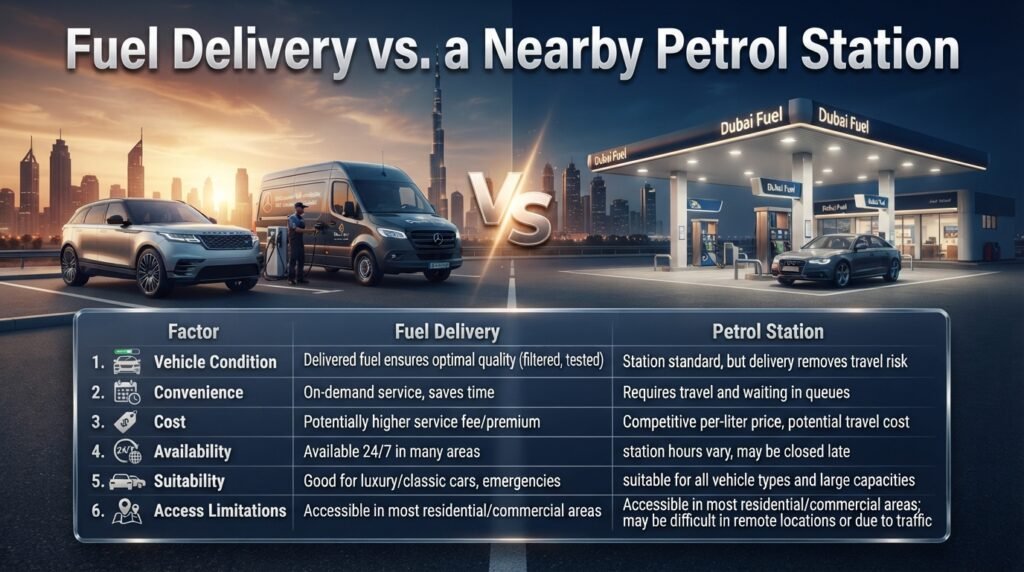
Drivers often need to decide whether to investigate vehicle fuel delivery or find a nearby petrol station. The right answer depends on whether the vehicle can travel safely and what assistance is available.
| Decision factor | Fuel-delivery option | Nearby petrol station |
|---|---|---|
| Vehicle condition | May be relevant if the vehicle cannot reach a station | Suitable when the vehicle can reach the station safely |
| Convenience | Assistance may come to an eligible location | Driver must travel to the station |
| Cost | May involve delivery or call-out charges | Usually avoids a separate delivery charge |
| Availability | Depends on authorised providers and location | Depends on station location and operating arrangements |
| Vehicle suitability | Must be confirmed with the provider | Depends on the station’s available fuel |
| Access limitations | The location must be suitable for fuel handling | The driver must be able to reach the station safely |
When is a nearby station the better choice?
A petrol station is often the simpler option when the vehicle has enough fuel to reach it safely and the route does not introduce an unreasonable risk.
It may also be preferable for routine refuelling because the driver can plan the stop and avoid additional assistance charges.
However, a short distance on a map does not automatically mean that the station is safely reachable. Consider traffic, road layout, remaining fuel, and the vehicle’s actual condition.
When should you investigate fuel assistance?
Fuel assistance may be worth investigating when the vehicle is immobilised in a safe, accessible location and an appropriately authorised provider can legally serve it.
It may also be relevant when moving the vehicle would be unsafe or impractical.
The important point is not to choose delivery automatically. First identify the problem, then compare the safe and available alternatives.
How Much Does Fuel Delivery for Vehicles Cost in Dubai?
There is no single price that applies to every vehicle fuel-delivery arrangement. The total amount depends on the provider, the fuel quantity, the vehicle, the location, and any additional requirements.
Understanding the possible cost components helps drivers ask better questions before confirming assistance.
Fuel quantity and type
The cost of the fuel itself depends on the amount supplied and the applicable price. Petrol and diesel requirements may differ according to the vehicle.
Do not request more fuel than you need simply because it appears convenient. The quantity should be appropriate for the vehicle and the circumstances, and the provider should follow its authorised procedures.
Delivery or call-out charges
A provider may charge for sending an appropriately equipped vehicle to a location. The charge may depend on its pricing structure and the circumstances of the request.
Ask whether the quoted fee includes the fuel or whether fuel is billed separately.
Distance and accessibility
The location can affect the practicality and cost of assistance. A provider may have different arrangements for different coverage areas, while a restricted site may be inaccessible altogether.
Confirm the location before accepting an estimate.
Vehicle type and special requirements
A motorcycle, passenger car, light commercial vehicle, and heavy truck may not require the same equipment or arrangements.
If your vehicle has unusual requirements, explain them before confirming the request. Do not assume that every provider serves every category.
How to avoid unexpected charges
Before agreeing to assistance, ask:
- What is the complete estimated price?
- Is fuel charged separately from the delivery fee?
- Is there a minimum fuel quantity?
- Could distance or waiting time affect the amount?
- Are there restrictions that might prevent the provider from reaching the vehicle?
- Which payment methods are accepted?
- What happens if the vehicle requires recovery instead of fuel?
💡 Pro tip: Compare the full cost of each safe option rather than comparing fuel prices alone. If your vehicle cannot move safely, avoiding a delivery charge should not take priority over personal safety.
A Practical Guide to On-Demand Refuelling Choices in Dubai
When your car’s petrol level becomes lower than expected, having a clear plan can help you decide what to do next. Consider your current location, the distance to the nearest suitable petrol station, and whether you can reach it safely without risking a roadside breakdown. If you are exploring on-demand refuelling options, review the provider’s authorisation, service-area limitations, vehicle requirements, estimated response time, and full pricing before making arrangements. Remember that availability can vary depending on the location and provider, so confirm the relevant details directly instead of relying on assumptions. For additional guidance on researching these options and understanding what to check before choosing one, visit 👉🏻 On-Demand Petrol Delivery Dubai.
How to Evaluate a Fuel-Delivery Provider
Choosing a provider requires care because petrol and diesel are flammable substances. A suitable provider should be able to explain its authorisation, equipment, operating conditions, and fuel-handling procedures.
Check the provider’s legal authorisation
Confirm that the provider is authorised for the specific fuel-delivery or refuelling activity it offers in Dubai.
The relevant permissions and requirements can depend on the activity being carried out. A business that provides general roadside assistance should not automatically be assumed to have permission to transport and supply fuel.
Ask for clear information about the provider’s credentials if you are unsure.
Confirm the fuel and vehicle requirements
Explain whether your vehicle uses petrol or diesel and whether it has any special requirements.
Confirm that the provider can serve the vehicle type and location before proceeding.
This is especially important for diesel-powered vehicles, motorcycles, commercial fleets, and larger vehicles that may require different arrangements.
Understand location restrictions
A provider may not be able to serve every road, tunnel, basement car park, industrial site, or secured building.
Check whether the proposed location is approved and accessible. If necessary, ask the relevant facility or site management about its requirements.
Never assume that a service advertised as mobile can operate anywhere.
Review the price and payment arrangements
A clear quote should explain the charges and any conditions that could affect the final amount.
Be cautious if the provider cannot explain its pricing, avoids answering basic questions, or pressures you to confirm before disclosing important terms.
Use a payment method that provides an appropriate record of the transaction.
Evaluate communication and professionalism
Good communication is important during a fuel emergency.
A provider should be able to explain what information it needs, whether it can serve your location, what the expected process involves, and what to do if refuelling does not resolve the problem.
Do not judge reliability solely by an attractive advertisement or a claim of exceptionally fast arrival.
Understand the limits of this website
PetrolStationNearMeDubai is an informational website in this context. Readers should independently verify the authorisation, availability, prices, and terms of any third-party provider they consider.
The presence of a fuel-related article does not mean that a provider has been checked, endorsed, or booked through this website.
Safety Considerations Before Arranging Fuel Assistance
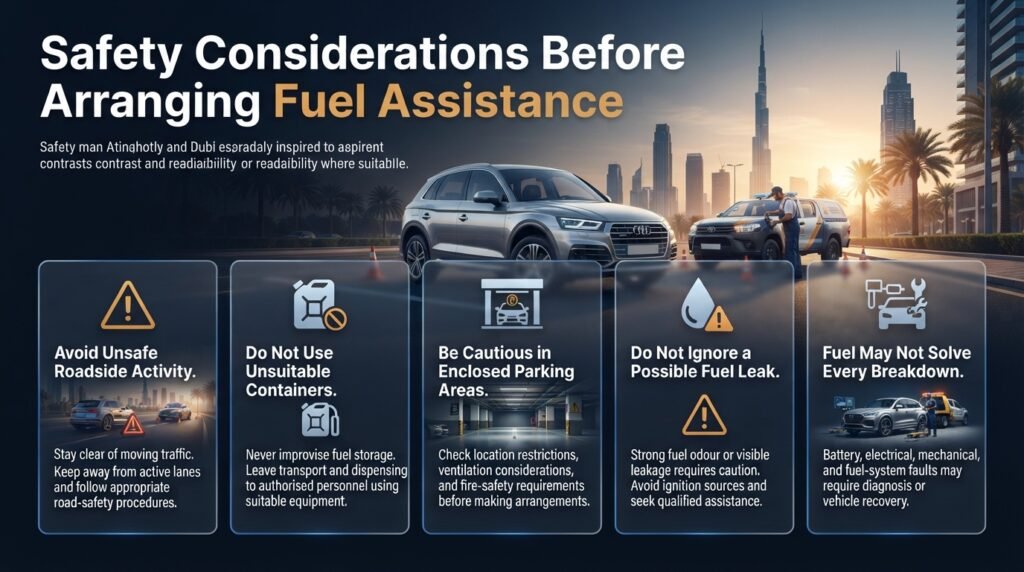
Safety is one of the most important parts of any discussion about vehicle fuel delivery. Drivers should understand that transporting, storing, and supplying petrol or diesel involves specific risks and regulatory requirements.
Avoid unsafe roadside activity
If your vehicle stops on a busy road, do not attempt to transfer fuel beside moving traffic.
Follow appropriate road-safety procedures, keep away from active lanes, and contact the relevant authorities if the vehicle creates a hazard.
A safe location is more important than arranging the quickest possible refuelling option.
Do not use unsuitable containers
Petrol should not be transferred using an ordinary bottle or another container that is not designed and approved for the purpose.
Improvised fuel handling can create risks of leakage, fire, exposure, and contamination.
Leave fuel transport and dispensing to appropriately authorised personnel using suitable equipment.
Be cautious in enclosed parking areas
Underground garages and enclosed parking areas can introduce additional risks because of ventilation, access restrictions, and fire-safety requirements.
Confirm whether the location permits the proposed activity before making arrangements.
If the location is unsuitable, the provider or facility management may need to identify an approved alternative.
Do not ignore a possible fuel leak
If you notice a strong fuel smell, visible leakage, or other signs of a fuel-system problem, do not assume that adding more fuel is appropriate.
Avoid ignition sources and follow the relevant emergency procedures. Seek qualified assistance before attempting to operate the vehicle.
Never assume that fuel will solve every breakdown
A vehicle that stops unexpectedly may have a battery, electrical, mechanical, or fuel-system fault.
Accurate information helps the appropriate professional decide whether fuel, diagnosis, or recovery is needed.
What Should You Do If Your Vehicle Runs Out of Fuel on a Highway?
A highway fuel shortage is different from running out of petrol in an ordinary parking area. The risk comes not only from the empty tank but also from the vehicle’s position relative to moving traffic.
Step 1: Prioritise immediate safety
If the vehicle can be moved to an appropriate safe location without creating additional danger, follow the relevant road-safety guidance.
Use hazard lights when appropriate and avoid standing in a live lane.
Do not attempt to push the vehicle across moving traffic or walk along the carriageway to look for fuel.
Step 2: Contact the appropriate assistance
If the vehicle is in a dangerous position, contact the relevant emergency or road-authority service.
Do not assume that a routine fuel-delivery vehicle is permitted to stop at every roadside location.
Step 3: Share accurate location details
Provide the road name, direction of travel, nearest exit or landmark, and other location details when safe to do so.
If the vehicle is in a tunnel, follow the instructions provided at the location and by the relevant authorities.
Step 4: Confirm whether fuel assistance is appropriate
Once the immediate hazard has been addressed, determine whether an authorised provider can legally and safely assist.
Depending on the location and circumstances, recovery or another roadside-support option may be more appropriate than refuelling in place.
Can Fuel Delivery Help Businesses Manage Fleet Vehicles?
Businesses that operate several vehicles may investigate authorised fuel assistance as one part of their wider fleet-management process.
However, emergency assistance should not replace routine fuel monitoring. A business can often reduce avoidable interruptions by establishing clear procedures and ensuring that drivers understand their responsibilities.
Establish a minimum fuel threshold
Set a reasonable refuelling threshold for each vehicle category.
The appropriate threshold depends on vehicle use, typical routes, tank capacity, fuel consumption, and access to refuelling locations.
Drivers should understand when to refuel rather than waiting until the warning light appears or the tank becomes nearly empty.
Plan refuelling around routes
Fleet managers can identify suitable refuelling opportunities when planning routes and schedules.
For example, a delivery van travelling between several commercial districts may be able to refuel during a planned break rather than risking a shortage near the end of a shift.
Route planning should account for traffic, vehicle load, expected travel distance, and realistic fuel consumption.
Keep vehicle records accurate
Maintain information about each vehicle’s fuel type, registration details, normal operating area, and relevant assistance arrangements.
This can help managers respond more efficiently when a driver reports a fuel-related problem.
For mixed fleets, accurate records are especially important because petrol and diesel vehicles may have different requirements.
Create a clear breakdown procedure
Drivers should know whom to contact, what information to provide, and when to seek emergency assistance.
A practical procedure can include:
- Reporting the vehicle’s exact location.
- Describing the fuel warning or breakdown symptoms.
- Confirming the correct fuel type.
- Assessing whether the location is safe.
- Contacting the appropriate manager or assistance provider.
- Recording the incident and its cost.
- Arranging further diagnosis if the vehicle remains immobilised.
Review recurring incidents
If the same vehicles repeatedly run low on fuel, investigate the cause.
Possible reasons include poor route planning, inaccurate fuel records, unusual consumption, or drivers misunderstanding the refuelling policy.
Reviewing these incidents can help a business reduce avoidable delays without relying on repeated emergency requests.
For a broader vehicle-focused overview, see Petrol Delivery for Vehicles in Dubai.
Common Mistakes to Avoid When Looking for Fuel Delivery
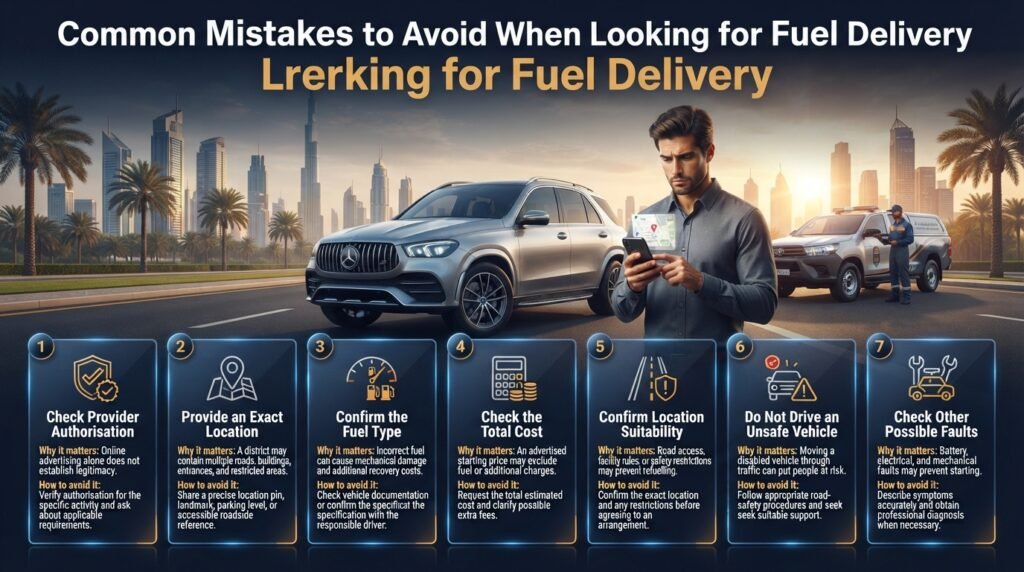
Fuel emergencies can create pressure to make quick decisions. Recognising common mistakes can help drivers avoid unnecessary costs and safety risks.
Mistake 1: Assuming every provider is authorised
Why it happens: An online advertisement may make a service appear legitimate without explaining its permissions.
Why it matters: Fuel transportation and dispensing are regulated activities, and an unsuitable provider may not be permitted to carry them out.
How to avoid it: Verify the provider’s authorisation for the specific activity and ask how it complies with applicable requirements.
Mistake 2: Giving an incomplete location
Why it happens: Drivers may assume that naming a district is enough.
Why it matters: A large district may contain many roads, buildings, entrances, and restricted areas.
How to avoid it: Provide a precise location pin, landmark, parking level, or accessible roadside reference.
Mistake 3: Guessing the fuel type
Why it happens: Drivers may be unfamiliar with the vehicle or may be arranging assistance for someone else.
Why it matters: Incorrect fuel can cause mechanical damage and create additional recovery costs.
How to avoid it: Check the vehicle documentation or ask the responsible driver to confirm the specification.
Mistake 4: Focusing only on the advertised price
Why it happens: A low starting price may appear attractive during an emergency.
Why it matters: The final amount may include additional charges or may not include the fuel itself.
How to avoid it: Ask for the total estimated cost and clarify any conditions that could change it.
Mistake 5: Assuming every location can be served
Why it happens: The phrase “mobile fuel delivery” may sound as though assistance is available anywhere.
Why it matters: Road access, facility rules, and safety restrictions may prevent refuelling at the vehicle’s current position.
How to avoid it: Confirm the exact location and any restrictions before agreeing to the arrangement.
Mistake 6: Continuing to drive after the vehicle has stalled
Why it happens: A driver may hope to reach a nearby station without requesting assistance.
Why it matters: Attempting to move a disabled vehicle through traffic can put the driver and others at risk.
How to avoid it: Follow road-safety procedures and seek the appropriate support when the vehicle cannot move safely.
Mistake 7: Treating every starting problem as an empty tank
Why it happens: An engine that will not start can make the fuel gauge seem like the obvious explanation.
Why it matters: A battery fault or mechanical problem will not necessarily be resolved by adding fuel.
How to avoid it: Describe the symptoms accurately and obtain professional diagnosis when the cause is uncertain.
Expert Tips for Preventing Vehicle Fuel Emergencies
Preparation is usually easier than dealing with an unexpected stop. Drivers and fleet managers can take several practical steps to reduce the likelihood of a fuel-related disruption.
Monitor fuel levels consistently
Do not depend entirely on the dashboard’s estimated remaining range.
Actual fuel consumption can change with congestion, driving conditions, vehicle load, air-conditioning use, and driving habits.
Refuel before the tank reaches a critically low level, especially before longer journeys or travel through unfamiliar areas.
Understand your vehicle’s fuel requirements
Know whether the vehicle uses petrol or diesel and follow the manufacturer’s specifications.
If you manage multiple vehicles, maintain a simple record of their fuel types and relevant operating requirements.
This is particularly useful when different drivers use different vehicles.
Keep useful information accessible
Make sure you can identify your vehicle and location quickly.
Useful information may include the vehicle make and model, registration details, fuel specification, roadside-assistance arrangements, and emergency contacts.
Keep personal information secure and share only what is reasonably required.
Plan longer journeys realistically
Before travelling across Dubai, consider the route, expected traffic, available refuelling opportunities, and the vehicle’s fuel consumption.
Do not rely on a best-case travel estimate when the journey may involve congestion or detours.
Learn when to choose recovery
If the vehicle has a mechanical problem, is stopped in a restricted area, or cannot be approached safely, fuel delivery may not be the appropriate solution.
Understand the difference between refuelling, roadside diagnosis, and vehicle recovery so that you can request the right type of assistance.
Keep business procedures simple
Fleet drivers should know the minimum fuel threshold, reporting process, and person responsible for approving assistance.
A clear procedure reduces confusion and helps managers make decisions based on safety, cost, and vehicle requirements.
Expert recommendation: Research your options before an emergency occurs. Knowing how to verify a provider, communicate your location, and confirm your fuel type can make a stressful situation easier to manage.
How Can You Prepare for a Vehicle Fuel Emergency?
A simple preparation routine can help private drivers and businesses respond more effectively.
Before travelling
- Check the fuel gauge.
- Consider the distance and expected traffic.
- Confirm the correct fuel specification.
- Identify suitable refuelling opportunities for longer journeys.
- Make sure relevant roadside-assistance information is accessible.
If the vehicle runs out of fuel
- Prioritise your safety and the safety of other road users.
- Avoid active traffic and unsafe attempts to move the vehicle.
- Identify the exact location.
- Describe the vehicle and the problem accurately.
- Check whether an authorised provider can serve the location.
- Confirm the total cost and any restrictions.
- Arrange further diagnosis or recovery if necessary.
After the incident
Consider why the shortage occurred.
If it resulted from an unusual journey, a simple change in planning may be sufficient. If it happens repeatedly, investigate fuel consumption, dashboard warnings, refuelling habits, or possible vehicle problems.
For businesses, recording incidents can reveal recurring patterns and help improve fleet procedures.
How Can I Get Fuel Delivery for My Vehicle in Dubai If I Run Out of Petrol?
Running out of petrol in Dubai can be stressful, especially when your vehicle stops in an unfamiliar area or you cannot reach the nearest petrol station safely. The first step is to assess your surroundings and make sure you and your vehicle are in a safe position. If the vehicle is stranded in a hazardous location, such as an active traffic lane, prioritise road safety and contact the appropriate road-assistance or emergency authority.
Once you are in a safe position, identify your exact location and confirm your vehicle’s fuel requirements. You can then investigate whether an appropriately authorised fuel-delivery provider serves your area and can assist with your particular vehicle. Before confirming an arrangement, ask about availability, the estimated arrival time, and the total cost, including any delivery charges.
Important points to remember:
Share your precise location, including a nearby landmark or parking entrance.
Confirm whether your vehicle requires petrol or diesel.
Check that the provider is authorised and can safely access your location.
Request the complete price before agreeing to assistance.
If the vehicle still will not start after refuelling, arrange professional diagnosis or recovery.
How Much Does Fuel Delivery for Vehicles Cost in Dubai?
The cost of fuel delivery for vehicles in Dubai depends on the provider, the amount of fuel required, the delivery location, and the type of vehicle. Some arrangements may include a separate call-out or delivery charge in addition to the cost of petrol or diesel. Distance, access restrictions, and special vehicle requirements may also affect the final price.
For this reason, drivers should avoid relying on an advertised starting price without checking what it includes. A clear quote should explain the fuel cost, any delivery fee, minimum fuel requirements, possible additional charges, and accepted payment methods. If your vehicle can reach a nearby petrol station safely, compare that option with the complete delivery quote. If it cannot, prioritise safety when deciding how to proceed.
Before confirming fuel assistance, check the following:
Whether the fuel price is included in the quoted amount.
Whether a separate call-out or delivery fee applies.
Whether the provider charges according to distance or waiting time.
Whether your vehicle type and location are covered.
Whether additional costs could arise if recovery is required instead.
Can Fuel Be Delivered to Cars, Motorcycles, SUVs, and Commercial Vehicles in Dubai?
Fuel assistance may be available for different vehicle categories, but eligibility depends on the provider’s capabilities, the correct fuel type, and the location where assistance is requested. A passenger car, motorcycle, SUV, delivery van, and heavy commercial vehicle may have different fuel requirements and access considerations. Therefore, drivers should not assume that a provider serving cars can automatically assist every other vehicle type.
When making enquiries, explain the vehicle’s make or model where relevant, its fuel specification, and its exact location. Commercial vehicles may require additional checks because of their size, fuel capacity, or restricted operating areas. Electric vehicles require a different solution altogether because they use battery power rather than petrol or diesel.
Consider these factors before requesting assistance:
Cars and SUVs: Confirm the correct fuel specification and location access.
Motorcycles: Check that the provider can accommodate the motorcycle’s fuel requirements.
Vans and fleet vehicles: Confirm vehicle compatibility and any operational restrictions.
Heavy commercial vehicles: Ask whether specialised equipment or arrangements are required.
Electric vehicles: Investigate suitable charging support or vehicle recovery instead of conventional fuel delivery.
Is Fuel Delivery Better Than Finding the Nearest Petrol Station in Dubai?
Fuel delivery and conventional petrol-station refuelling serve different needs. A nearby petrol station is often the more straightforward option when your vehicle can reach it safely. It allows you to refuel at a designated location without necessarily paying an additional delivery charge. However, if your vehicle has already run out of fuel and cannot move safely, a petrol station may not be a practical immediate solution.
In that situation, an authorised fuel-delivery arrangement may be worth investigating if the provider can legally and safely reach the vehicle. The decision should account for the vehicle’s condition, traffic, distance, location restrictions, availability, and total cost. The closest station on a map is not necessarily the safest or most accessible option.
Use these considerations to make a practical decision:
Choose a nearby station when the vehicle can reach it safely.
Investigate fuel assistance when the vehicle is immobilised in an appropriate location.
Consider roadside recovery if the vehicle has a mechanical problem or is in a restricted area.
Compare the full cost rather than fuel prices alone.
Never risk personal safety to avoid a delivery fee.
What Should I Do If My Vehicle Runs Out of Fuel on a Dubai Highway?
Running out of fuel on a highway requires particular care because the vehicle’s position may expose you and other road users to moving traffic. Do not attempt to walk along the carriageway, push the vehicle through traffic, or arrange an improvised fuel transfer beside the road. Use hazard lights when appropriate and follow the relevant road-safety instructions.
If the vehicle is stopped in a dangerous position, contact the appropriate road-authority or emergency service. Once the immediate safety concern has been addressed, establish your exact location and explain the vehicle’s fuel requirements. A routine fuel-delivery provider may not be permitted to stop at your precise location, so recovery or assistance at an approved location may be necessary.
Follow these safety priorities:
Move to a safe position when possible without creating additional danger.
Avoid standing in active traffic or attempting unsafe roadside repairs.
Provide accurate location details when it is safe to do so.
Confirm whether fuel assistance is permitted at that location.
Seek professional diagnosis if the vehicle remains unable to start after refuelling.
Conclusion: Choosing the Right Fuel Delivery Option for Vehicles in Dubai
Fuel delivery for vehicles in Dubai can be a practical option when a car, motorcycle, SUV, van, or commercial vehicle runs out of petrol and cannot conveniently reach a fuel station. Understanding how fuel assistance works, what factors influence its cost, and which safety precautions to follow can help drivers make informed decisions during unexpected fuel emergencies. However, fuel delivery is not always necessary; when a nearby petrol station is safely accessible, conventional refuelling may be the simpler and more economical choice.
Before arranging assistance, drivers should confirm their exact location, identify the correct fuel type, explain their vehicle’s requirements, and verify the provider’s authorisation, availability, estimated arrival time, and total charges. If a vehicle stops on a busy road or highway, personal safety should always come first. Move to a safe location if possible, use hazard lights when appropriate, and contact the relevant roadside assistance or emergency service if the situation presents a danger.
For more information about locating petrol stations and understanding available fuel-related options, explore PetrolStationNearMeDubai. You can also read the dedicated guides on Petrol Delivery Dubai and Emergency Petrol Delivery Dubai to learn more about fuel assistance scenarios.
Ultimately, preparation is the best way to reduce the inconvenience of running out of petrol. Monitor your fuel level, plan refuelling stops before longer journeys, and keep suitable assistance details available. With the right information and a safety-first approach, drivers and vehicle owners can handle fuel shortages more confidently and make sensible refuelling decisions across Dubai.
Leave a Reply