Introduction
Petrol Delivery for Motorcycles in Dubai | Running out of petrol on a motorcycle is one of those problems that can happen when you least expect it. You may be travelling to work, completing deliveries, returning home after a long ride, or simply exploring another part of Dubai when the engine suddenly starts losing power and eventually stops.
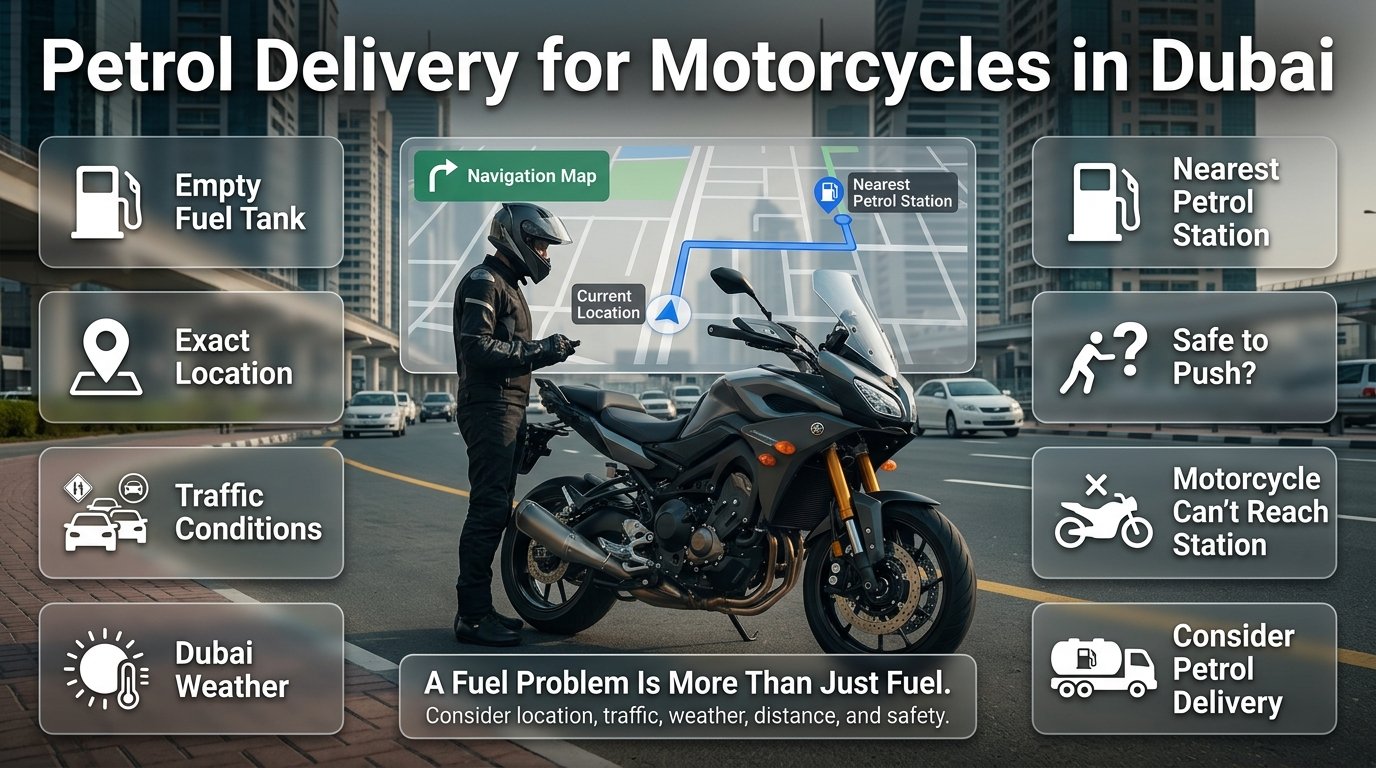
At that point, the problem is no longer simply about fuel. You also have to think about traffic, weather, your exact location, the distance to the nearest petrol station, and whether it is actually safe to push the motorcycle.
This is where petrol delivery for motorcycles in Dubai can become relevant. When a motorcycle cannot conveniently reach a petrol station because its tank is empty, getting suitable fuel to the bike may be a more practical option than attempting a long or unsafe journey on foot.
For general information about petrol-related options in Dubai, you can also explore PetrolStationNearMeDubai.
This guide explains what motorcycle petrol delivery means, when it may be useful, how to handle a fuel emergency, what information to provide, how to stay safe while waiting, what common mistakes riders make, and how to prevent the same problem from happening again.
What Is Petrol Delivery for Motorcycles in Dubai?
Petrol delivery for motorcycles in Dubai refers to bringing an appropriate quantity of fuel to a motorcycle when the rider cannot conveniently reach a petrol station. It is mainly relevant to situations where the bike has run out of fuel or is stranded because there is no practical way to refuel normally.
The exact availability, operating area, fuel quantity, pricing and process can vary depending on the provider and the rider’s location.
The basic idea is straightforward:
Normal situation:
Motorcycle → Petrol station → Refuel → Continue journey
Fuel emergency:
Motorcycle cannot reach station → Request suitable assistance → Fuel reaches motorcycle → Refuel safely → Continue or reach a station
The important distinction is that petrol delivery is generally a backup option, not a replacement for normal fuel planning.
A rider who checks fuel regularly and refuels before the tank becomes critically low will normally have fewer problems. However, unexpected situations can still happen.
For example, a rider may:
- Misjudge the motorcycle’s remaining range.
- Forget to refuel before a long journey.
- Enter an unfamiliar part of Dubai.
- Face an unexpected detour.
- Spend longer than expected in traffic.
- Ignore a low-fuel warning.
- Discover that the nearest accessible station is farther away than expected.
- Experience a fuel gauge that doesn’t accurately reflect the remaining usable fuel.
The goal during an emergency is not to panic. It is to identify the problem, protect yourself from traffic, establish your location and choose the safest practical solution.
Why Do Motorcycles Run Out of Petrol in Dubai?
Running out of petrol isn’t always the result of irresponsible riding. Sometimes the problem develops because several small factors combine.
Dubai’s road network covers a large area, and a journey that looks short on a map can become considerably longer because of traffic, road layouts, detours or access restrictions.
Common reasons include:
1. Ignoring the low-fuel warning
Many riders see the warning and assume they can continue for quite a while.
That can be risky because the remaining range isn’t necessarily a fixed number.
Your motorcycle’s fuel consumption can change according to:
- Traffic
- Riding style
- Load
- Road conditions
- Speed
- Frequent stops
- Weather
- Engine condition
A warning should therefore be treated as a reminder to plan your next refuelling stop.
2. Depending entirely on the fuel gauge
A fuel gauge provides useful information, but it shouldn’t always be treated as a precise distance calculator.
The difference between “some fuel remaining” and “enough fuel to reach my destination” can become important when travelling across Dubai.
3. Forgetting to refuel
This sounds obvious, but it happens.
A rider may finish a busy shift, park the motorcycle and remember the fuel issue only when leaving again.
4. Unexpected route changes
A road closure, missed turn or navigation change can increase the distance significantly.
5. Unfamiliar areas
A rider may know where petrol stations are around their normal route but have no idea where the next convenient station is after entering another area.
6. Long working shifts
Delivery riders can spend many hours on motorcycles. The more kilometres a bike covers, the more important fuel planning becomes.
RTA has also highlighted the importance of rider safety, training and motorcycle maintenance within Dubai’s delivery sector.
When Should You Consider Motorcycle Petrol Delivery?
The best time to think about fuel delivery is not necessarily when the motorcycle has been sitting empty for an hour.
The real decision should be based on whether the motorcycle can safely and realistically reach fuel.
Ask yourself:
Can I reach a petrol station without putting myself or other road users at unnecessary risk?
If the answer is yes, normal refuelling may be the simplest solution.
If the motorcycle has stopped and the nearest practical station is too far away, or pushing the bike would expose you to difficult traffic or excessive physical effort, a suitable fuel-delivery option may make more sense.
Petrol delivery may be relevant when:
- The tank is empty.
- The motorcycle has stopped because of fuel shortage.
- The nearest petrol station is not realistically reachable.
- You are in an unfamiliar area.
- The motorcycle is difficult to push.
- Weather conditions make walking or pushing uncomfortable.
- You are carrying delivery equipment or other luggage.
- You are stranded at an inconvenient time.
- You need fuel before the motorcycle can move again.
It may not be the right solution when:
- The motorcycle already has sufficient fuel.
- The engine has a mechanical fault.
- The battery is dead.
- There is an electrical problem.
- The motorcycle has suffered an accident.
- You don’t know what caused the breakdown.
Adding petrol cannot fix every motorcycle problem.
💡 Pro Tip: Before requesting fuel, take a moment to establish whether the motorcycle is actually empty. If the engine stopped suddenly but the tank still contains fuel, the problem may require a different type of assistance.
What Should You Do First When Your Motorcycle Runs Out of Petrol?
The first priority is not finding petrol.
It is getting yourself into the safest practical position.
A motorcycle rider has considerably less physical protection than someone inside a car. Standing beside a stranded motorcycle near moving traffic can therefore create a second problem while you’re trying to solve the first.
Follow this basic sequence:
- Stay calm.
- Control the motorcycle if possible.
- Move yourself away from dangerous traffic when it is safe to do so.
- Determine whether the motorcycle is actually out of fuel.
- Identify your exact location.
- Check whether a nearby petrol station is realistically accessible.
- If necessary, consider appropriate fuel assistance.
- Keep your phone available.
- Follow safe fuel-handling procedures once assistance arrives.
Do not put yourself into an active traffic lane simply because you want to push the motorcycle closer to a station.
RTA’s motorbike safety guidance emphasises safe riding behaviour, following road signs and signals, avoiding dangerous riding practices and maintaining safe distances.
The same basic principle applies during a breakdown: don’t allow a fuel problem to become a traffic-safety problem.
How Does Petrol Delivery for a Motorcycle Work?
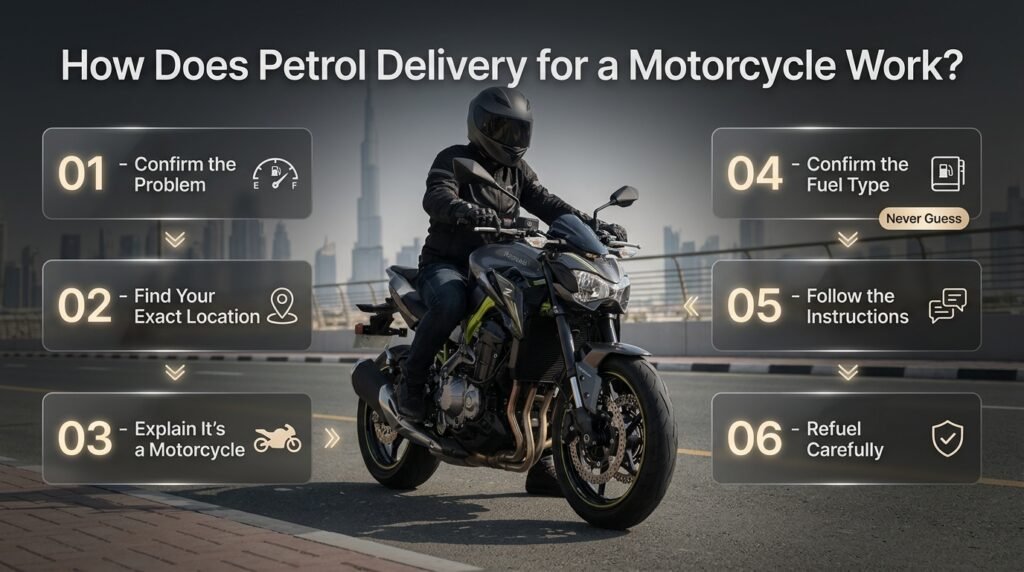
The exact procedure can differ, but the overall process is usually simple.
Step 1: Confirm the problem
Determine whether the motorcycle appears to have run out of fuel.
Think about:
- How much fuel was in the tank before the journey.
- Whether the fuel warning appeared.
- Whether the engine stopped after low-fuel symptoms.
- Whether you recently refuelled.
- Whether another warning appeared.
If there is enough fuel but the motorcycle still won’t start, fuel delivery may not solve the problem.
Step 2: Find your exact location
Location is one of the most important pieces of information in any roadside request.
Don’t simply say:
“I’m in Dubai.”
Even a neighbourhood name may not be enough.
Try to provide:
- Road name
- Nearby building
- Landmark
- Direction of travel
- Parking location
- Service road
- Map pin
- Clearly identifiable entrance
A precise location reduces confusion.
Step 3: Explain that the vehicle is a motorcycle
Tell the provider exactly what vehicle needs assistance.
A motorcycle is different from a car in terms of:
- Fuel-tank size
- Fuel access
- Parking position
- Physical dimensions
- Rider safety
- Refuelling procedure
Vehicle-specific information makes the request clearer.
Step 4: Confirm the fuel type
Never guess.
Check the motorcycle manufacturer’s specifications, owner’s manual, fuel-cap information or another reliable source if you aren’t certain.
The correct fuel matters more than simply getting some fuel.
Step 5: Follow the provider’s instructions
You may be asked to confirm:
- Location
- Motorcycle type
- Fuel type
- Contact number
- Accessibility
- Quantity required
Provide the information accurately.
Step 6: Refuel carefully
When fuel arrives, don’t rush simply because you’ve been waiting.
The motorcycle should be positioned safely, ignition sources should be avoided and appropriate fuel-handling precautions should be followed.
What Information Should You Give When Requesting Motorcycle Fuel Delivery?
A clear request can save time.
Imagine two different messages.
Unclear request:
“Bike stopped. Need petrol in Dubai.”
The person receiving that message doesn’t know where you are, what happened or what fuel you need.
Better request:
“My motorcycle has run out of petrol and cannot move. I’m on the roadside near [specific location]. The motorcycle is safely positioned away from traffic. I need the appropriate petrol for the bike.”
The second message is much more useful.
Keep these details ready:
- Exact location
- Map pin
- Road name
- Nearby landmark
- Motorcycle type
- Fuel type
- Whether the tank is empty
- Whether the motorcycle is safely parked
- Any access information
⭐ Expert Tip: If you’re stranded, send your exact location before your phone battery gets low. A precise location is much more useful than trying to describe an unfamiliar road from memory.
Is It Better to Get Petrol Delivered or Find a Nearby Petrol Station?
There isn’t one answer for every rider.
The better choice depends on the motorcycle’s condition and location.
| Situation | Practical option |
|---|---|
| Motorcycle is running normally | Petrol station |
| Station is very close | Petrol station |
| Motorcycle has completely stopped | Fuel assistance may be suitable |
| Station is too far to reach safely | Consider delivery |
| Rider is unfamiliar with the area | Check location first |
| Mechanical fault suspected | Appropriate roadside assistance |
| Fuel type uncertain | Confirm before adding fuel |
If you’re trying to locate a normal refuelling point rather than dealing with a stranded motorcycle, the search intent is different.
A rider who needs a nearby refill should focus on station accessibility.
A rider whose motorcycle has already stopped needs to focus on recovery and safety.
That distinction is important because not every “near me” fuel search has the same intent.
Motorcycle Petrol Delivery vs Bike Petrol Refill
The terms may sound almost identical, but the user situation can be different.
A bike petrol refill search can indicate that a rider wants to find a convenient way to refuel a motorcycle near their current location.
A motorcycle petrol delivery search more strongly suggests that fuel needs to be brought to the motorcycle.
If your motorcycle can still move, reaching a petrol station may be easier.
If the motorcycle has stopped completely because the tank is empty, delivery may be more relevant.
For riders specifically looking for nearby bike refuelling options, see Bike Petrol Refill Near Me Dubai.
The key is to choose the solution based on the actual condition of the motorcycle rather than the wording of the search alone.
Petrol Delivery for Motorcycles vs Emergency Petrol Delivery
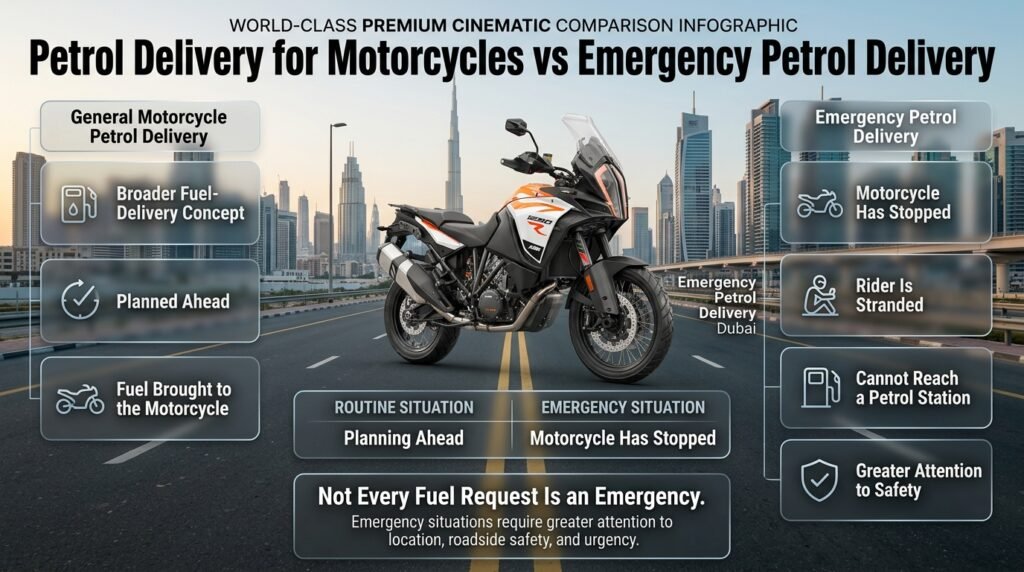
Another important distinction is between general fuel delivery and emergency fuel assistance.
General motorcycle petrol delivery can refer to the broader concept of getting petrol to a bike.
Emergency petrol delivery focuses on a situation where the rider is stranded or unable to continue because of a fuel shortage.
For example:
Routine situation:
You are planning ahead and want fuel brought to a motorcycle.
Emergency situation:
Your motorcycle has stopped and cannot reach a petrol station.
The second situation requires more attention to location, roadside safety and urgency.
If the motorcycle has already become stranded, the more specific Emergency Petrol Delivery Dubai topic may be relevant.
This separation also helps avoid treating every fuel request as an emergency.
What Is Bike Petrol Delivery in Dubai?
Bike petrol delivery is a motorcycle-focused approach to bringing fuel to a bike when the rider needs petrol away from a conventional refuelling point.
The motorcycle may be:
- A commuter bike
- A scooter
- A delivery motorcycle
- A small-engine bike
- A larger motorcycle
- A work motorcycle
- A personal-use motorcycle
The exact fuel requirements depend on the motorcycle.
The important part is communicating clearly that the vehicle is a bike rather than assuming a generic vehicle category automatically covers every motorcycle situation.
For riders specifically researching this topic, Bike Petrol Delivery Dubai provides the more focused motorcycle/bike context.
What Is Motorcycle Fuel Delivery in Dubai?
Motorcycle fuel delivery is a broader way of describing the delivery of petrol or fuel to a motorcycle when normal refuelling is inconvenient or impossible.
It can be relevant to:
- Private riders
- Commuters
- Delivery riders
- Long-distance riders
- Riders travelling through unfamiliar areas
- Riders dealing with unexpected fuel shortages
The phrase “motorcycle fuel delivery” focuses on the vehicle type, while “emergency fuel” focuses more on the problem situation.
Keeping these concepts separate helps riders understand what type of assistance they actually need.
For a dedicated guide focused on this vehicle-specific topic, see Motorcycle Fuel Delivery Dubai.
When Does Emergency Bike Fuel Make Sense?
Emergency bike fuel becomes relevant when the motorcycle’s fuel shortage has already stopped the journey.
Consider a rider who:
- Has an empty tank.
- Cannot reach a petrol station.
- Is carrying work equipment.
- Is in an unfamiliar part of Dubai.
- Is waiting in a difficult roadside location.
- Cannot reasonably push the motorcycle for a long distance.
In such cases, the goal is not to find the perfect long-term refuelling solution.
The goal is to get enough appropriate fuel into the motorcycle so the rider can safely recover from the immediate situation.
For this more specific situation, Emergency Bike Fuel Dubai covers the emergency motorcycle-fuel intent.
How Much Fuel Does a Motorcycle Need After Running Empty?
There is no universal amount that applies to every motorcycle.
A motorcycle’s fuel tank size varies considerably.
The amount required also depends on the immediate goal.
Sometimes the rider may simply need enough fuel to restart the motorcycle and reach a petrol station.
In another situation, the rider may need a larger amount depending on what the provider can supply and the motorcycle’s capacity.
Consider:
- Tank capacity
- Manufacturer requirements
- Distance to a suitable station
- Provider’s available quantity
- Current fuel condition
- Whether the motorcycle needs only emergency range
Do not request an arbitrary quantity without considering the motorcycle’s capacity.
💡 Pro Tip: The purpose of emergency fuel is often to restore mobility, not necessarily to replace a full routine refuelling stop.
Can Petrol Delivery Fix a Motorcycle That Won’t Start?
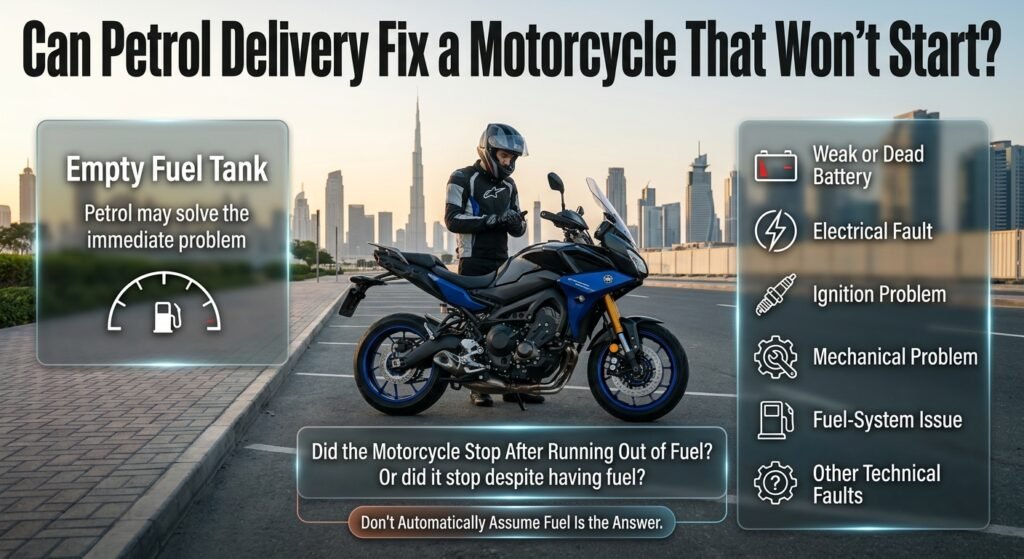
Not necessarily.
This is one of the most important distinctions for riders.
A motorcycle may fail to start because of:
- Empty fuel tank
- Weak or dead battery
- Electrical fault
- Ignition problem
- Mechanical problem
- Fuel-system issue
- Other technical faults
If the tank is empty, fuel may solve the immediate problem.
If the motorcycle has enough fuel but the engine still won’t start, adding more petrol isn’t likely to fix the actual cause.
A simple check
Ask:
Did the motorcycle stop after running out of fuel, or did it stop despite having fuel?
If you aren’t sure, don’t automatically assume fuel is the answer.
This can save time and prevent unnecessary fuel handling.
What Should You Do If the Motorcycle Stops on a Busy Road?
This situation requires extra caution.
A rider should first focus on personal safety and traffic exposure.
If possible:
- Move the motorcycle to a safer legal position.
- Stay away from moving traffic.
- Avoid standing in a blind spot.
- Keep yourself visible.
- Don’t attempt to cross dangerous lanes unnecessarily.
- Use your phone to identify the exact location.
- Request appropriate assistance.
Never assume that because you can physically push a motorcycle, you should push it.
The road environment matters.
A short distance on a quiet, safe surface is completely different from pushing a motorcycle beside fast-moving traffic.
Why Exact Location Matters in Dubai
Dubai includes dense urban areas, major highways, residential roads, industrial zones, service roads and complex entrances.
Two places within the same neighbourhood can be surprisingly difficult to reach from one another.
That means “I’m in Business Bay” may not be enough.
A better location description could include:
- Building name
- Road
- Direction
- Entrance
- Landmark
- Parking area
- Map pin
The more accurate your location, the easier it becomes to understand where the motorcycle is actually stranded.
This is particularly important when the rider isn’t familiar with the area.
What If You Are in an Unfamiliar Area of Dubai?
Don’t start pushing the motorcycle simply because you don’t recognise the area.
First use your phone to determine:
- Your current position
- The road you’re on
- Nearby petrol stations
- The direction of travel
- Accessible routes
- Safe places to wait
A map can also show a petrol station that appears close but may not actually be reachable from your side of the road.
This is why “nearest” doesn’t always mean “easiest to reach.”
A station may be physically close but separated by:
- Major roads
- Barriers
- One-way routes
- Restricted access
- Complex junctions
- Long detours
Always think in terms of practical accessibility, not just map distance.
Petrol Emergencies for Motorcycle Delivery Riders
Delivery riders have a different fuel-planning challenge.
A personal rider might travel 20 or 30 kilometres during a normal journey.
A delivery rider can cover considerably more distance throughout a working shift.
That means fuel planning needs to become part of the work routine.
RTA has specific programmes and requirements relating to delivery motorcycle riders, including rider qualification, safety training and motorcycle maintenance awareness.
Dubai has also expanded rest facilities for delivery riders. In 2026, RTA reported air-conditioned rest areas and additional temporary heat-stress protection measures for riders during the summer period.
These initiatives are important because a fuel emergency doesn’t happen in isolation. Heat, fatigue, traffic and long hours can all affect a rider’s ability to deal with a roadside problem safely.
Delivery riders should therefore:
- Start the shift with sufficient fuel.
- Monitor the fuel level regularly.
- Know convenient refuelling points.
- Avoid relying on the final portion of the tank.
- Take appropriate breaks.
- Keep the phone charged.
- Know how to identify their exact location.
How Hot Dubai Weather Can Make a Fuel Emergency Worse
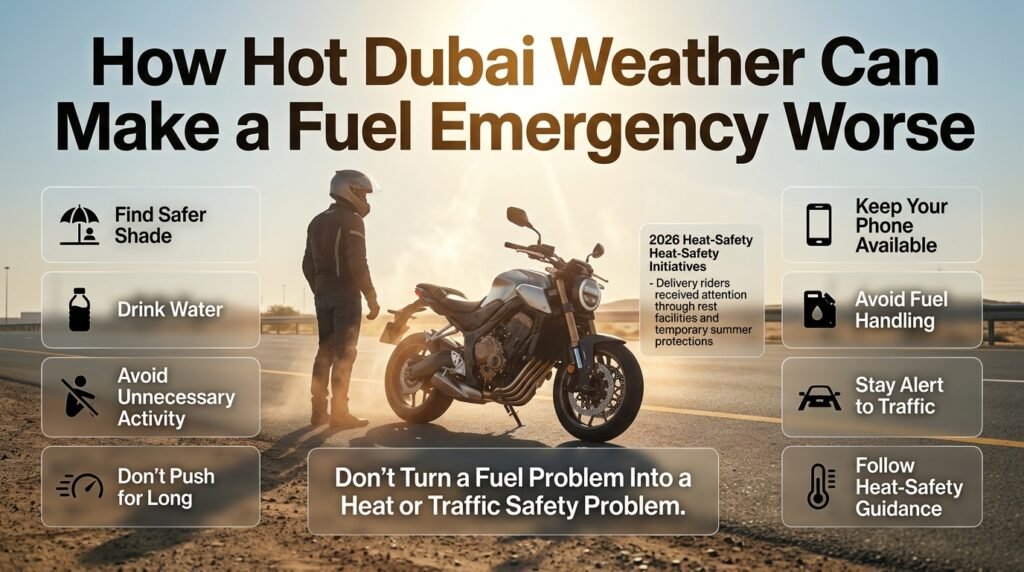
Heat changes the practical side of a roadside emergency.
Pushing a motorcycle may seem manageable for a few minutes, but the physical effort becomes more difficult under intense heat.
A rider waiting outside should avoid unnecessary exertion.
If you are stranded in hot conditions:
- Look for a safer shaded location where possible.
- Drink water.
- Avoid unnecessary physical activity.
- Don’t spend a long time pushing the bike.
- Keep your phone available.
- Avoid unnecessary fuel handling.
- Stay alert to traffic.
- Follow appropriate heat-safety guidance.
RTA’s 2026 initiatives specifically addressed heat stress for delivery riders, including rest facilities and temporary summer protections.
The lesson for any motorcycle rider is simple:
Don’t turn a fuel problem into a heat-related or traffic-safety problem.
Common Mistakes Riders Make During a Petrol Emergency
Mistake 1: Continuing to ride after the tank is effectively empty
If the motorcycle has already lost power because of fuel shortage, repeatedly trying to continue the journey doesn’t solve the underlying problem.
Better approach:
Stop trying to force the journey and assess the safest refuelling option.
Mistake 2: Pushing the bike too far
Pushing a motorcycle several kilometres can be exhausting.
Why it’s a problem:
- Heat
- Traffic
- Physical fatigue
- Road conditions
- Reduced awareness
Better approach:
Only push when the distance is short and the route is clearly safe.
Mistake 3: Standing directly beside traffic
A stranded motorcycle can attract the rider’s attention so strongly that they forget about surrounding vehicles.
Better approach:
Create as much separation from active traffic as reasonably possible.
Mistake 4: Giving an incomplete location
“Near Downtown” isn’t a precise location.
Better approach:
Use a map pin plus a road or landmark.
Mistake 5: Guessing the fuel type
Never rely on memory if you aren’t sure.
Better approach:
Check the motorcycle’s specifications before fuel is added.
Mistake 6: Assuming every breakdown is a fuel emergency
A motorcycle that won’t start may have another fault.
Better approach:
Think about what happened immediately before the engine stopped.
Mistake 7: Treating emergency delivery as normal refuelling
Emergency assistance can be useful, but relying on it for every fuel stop is poor planning.
Better approach:
Use normal petrol stations whenever the motorcycle is operating normally.
How Can You Prevent Running Out of Petrol?
Prevention is much easier than roadside recovery.
You don’t need complicated fuel calculations.
A simple routine is enough.
Before a long journey
Check:
- Current fuel level
- Expected distance
- Motorcycle’s approximate range
- Route
- Potential refuelling points
- Phone battery
During the journey
Pay attention to:
- Fuel warning
- Remaining range
- Detours
- Traffic
- Unexpected changes
Before a long work shift
Delivery riders should be even more careful.
Don’t start a long shift assuming the fuel currently in the tank will definitely last.
Fuel consumption isn’t perfectly predictable.
How to Estimate Your Motorcycle’s Real Fuel Range
One of the most useful things a rider can learn is the motorcycle’s real-world range.
Don’t rely only on a manufacturer’s theoretical figure.
Instead, observe your motorcycle over normal riding conditions.
For example:
If your motorcycle normally uses approximately a certain amount of fuel over a known distance, you can gradually understand its practical range.
But leave a safety margin.
Your actual consumption may change because of:
- Traffic
- Rider weight
- Passenger or luggage
- Riding style
- Speed
- Tyre condition
- Engine condition
- Road conditions
The goal isn’t to calculate the final possible kilometre.
The goal is to know when you should refuel.
How to Plan Fuel for a Long Dubai Motorcycle Journey
Before leaving, ask three simple questions:
1. How far am I travelling?
Estimate the full route rather than just the distance to your first destination.
2. Where can I refuel?
Identify practical refuelling points along the journey.
3. What happens if my route changes?
Leave enough fuel margin for unexpected detours.
A good fuel plan isn’t based on perfect conditions.
It’s based on realistic conditions.
What Should You Do After Receiving Emergency Petrol?
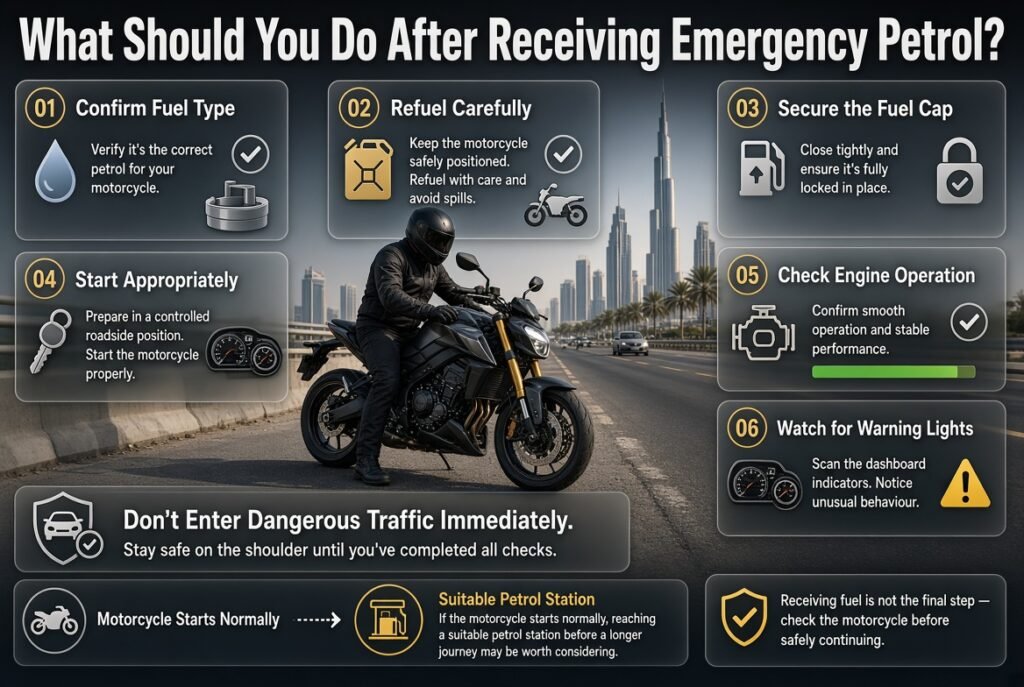
Once fuel arrives, don’t immediately assume the problem is completely over.
First:
- Confirm the fuel type.
- Refuel carefully.
- Secure the fuel cap.
- Start the motorcycle appropriately.
- Check that the engine is operating normally.
- Watch for warning lights or unusual behaviour.
- Avoid immediately entering a dangerous traffic situation.
If the motorcycle starts normally, consider reaching a suitable petrol station before continuing a long journey if the emergency quantity was only enough to restore mobility.
Should You Fill the Motorcycle Completely After an Emergency?
Not necessarily.
The correct amount depends on the motorcycle, the available fuel and the circumstances.
If emergency fuel was only intended to get you moving again, the next sensible step may be to reach a normal petrol station.
The important thing is not to confuse emergency fuel with a normal refuelling routine.
A rider who receives enough petrol to restart the motorcycle should still think about the next safe refuelling point.
What Are the Main Benefits of Motorcycle Petrol Delivery?
When available and appropriate, fuel delivery can solve a very specific problem.
It can restore mobility
The motorcycle cannot go anywhere without fuel.
It can reduce physical effort
The rider may avoid pushing the motorcycle a long distance.
It can be useful in unfamiliar areas
The rider doesn’t necessarily need to locate and reach a station independently.
It can help during work
For delivery riders, losing a motorcycle during a shift can create unnecessary downtime.
It can reduce unnecessary roadside movement
Instead of walking through an unfamiliar area looking for fuel, the rider can focus on staying safe and coordinating assistance.
What Are the Limitations of Petrol Delivery?
Petrol delivery isn’t a universal answer.
Availability can depend on:
- Location
- Provider
- Operating area
- Fuel type
- Quantity
- Road access
- Current circumstances
There can also be situations where the motorcycle needs mechanical assistance rather than fuel.
That’s why riders should first understand the problem.
Motorcycle Petrol Delivery vs Pushing the Motorcycle
| Factor | Petrol Delivery | Pushing |
|---|---|---|
| Physical effort | Lower | Higher |
| Traffic exposure | Can be reduced while waiting safely | May increase |
| Long distance | More practical | Difficult |
| Hot weather | Generally easier | More demanding |
| Availability | Depends on provider | Immediate |
| Mechanical problem | Doesn’t solve it | Doesn’t solve it |
| Empty tank | Directly relevant | Only a way to reach fuel |
Pushing is not automatically safer simply because it doesn’t involve waiting.
The road environment determines the risk.
Motorcycle Petrol Delivery vs Normal Petrol Station Refuelling
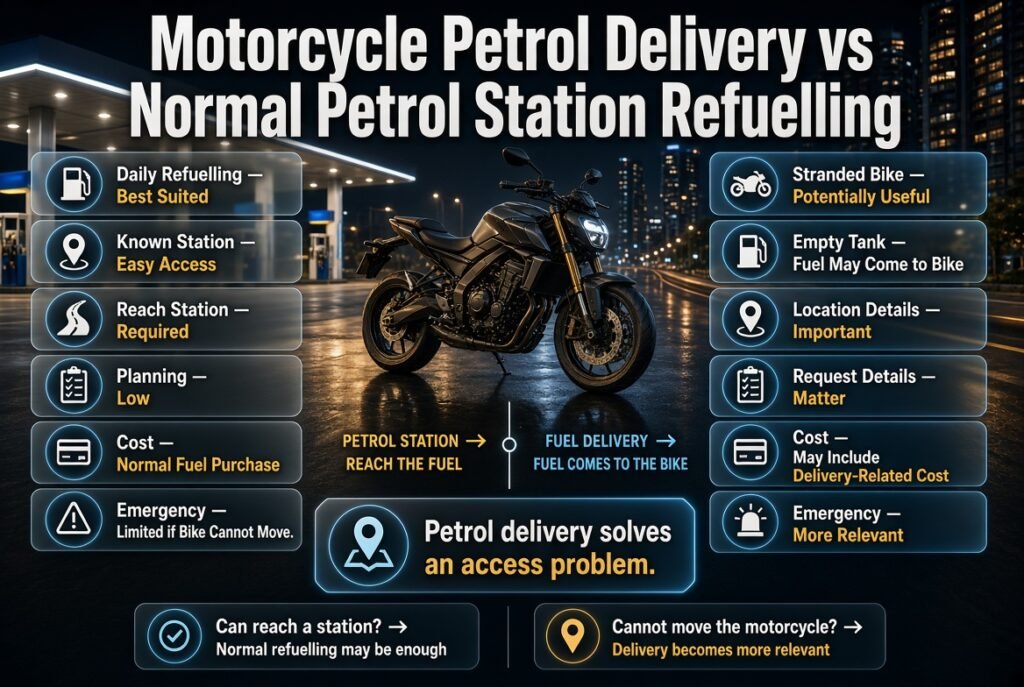
| Factor | Petrol Station | Motorcycle Fuel Delivery |
|---|---|---|
| Normal daily refuelling | Best suited | Usually unnecessary |
| Motorcycle stranded | May be inaccessible | Potentially useful |
| Empty tank | Requires reaching station | Fuel may come to bike |
| Planning required | Low once station is known | Location and request details matter |
| Cost | Normal fuel purchase | May involve additional delivery-related cost |
| Emergency use | Limited if bike cannot move | More relevant |
This comparison highlights the main idea:
Petrol delivery solves an access problem.
If you can easily access a petrol station, there may be little reason to use an emergency delivery option.
If you cannot move the motorcycle, the situation changes.
How to Choose a Reliable Fuel Assistance Option
Don’t judge an option only by phrases such as “fast” or “24-hour.”
Instead, look for clarity.
Before relying on an option, understand:
- Whether motorcycles are supported.
- Whether your location is covered.
- What fuel types are available.
- What information you need to provide.
- How the motorcycle should be positioned.
- What the process involves.
- What charges may apply.
A clear process is generally better than making assumptions.
Why Motorcycle-Specific Information Matters
A motorcycle isn’t simply a smaller car.
The rider is exposed to the road, the fuel tank may be positioned differently, and the bike can be harder to stabilise during roadside situations.
This is especially important for delivery motorcycles.
Dubai’s RTA has specific safety and regulatory requirements for delivery motorcycles and riders, covering areas such as protective equipment, motorcycle specifications, training and traffic safety.
That wider safety context is useful even when the immediate problem is only an empty fuel tank.
A fuel emergency should be handled as part of the overall roadside-safety situation.
What About Car Petrol Delivery?
The basic idea of delivering fuel can apply to different vehicles, but the user intent is different when the vehicle is a car.
A car has:
- A larger fuel tank
- Different roadside positioning
- Different access requirements
- Different physical dimensions
- Greater protection for occupants
If your actual problem involves a car rather than a motorcycle, see Car Petrol Delivery Dubai.
Keeping car and motorcycle topics separate is useful because a rider looking for motorcycle fuel help needs different practical information.
How to Handle a Motorcycle Fuel Emergency at Night
Night-time fuel emergencies can create additional visibility and safety issues.
A rider should avoid standing in poorly visible locations if a safer alternative is available.
Consider:
- Your visibility to approaching traffic.
- Whether the motorcycle is safely positioned.
- Whether your phone has enough battery.
- Whether you have an accurate map location.
- Whether you can wait somewhere safer.
- Whether the area is accessible.
Don’t walk along dangerous roads simply because a petrol station appears close on a map.
The shortest route isn’t always the safest route.
Can a Fuel Emergency Happen Even With a Good Motorcycle?
Yes.
Even a well-maintained motorcycle can run out of fuel.
Maintenance reduces the chance of mechanical problems, but it doesn’t prevent:
- Forgetting to refuel
- Misjudging range
- Unexpected detours
- Longer journeys
- Traffic
- Unfamiliar routes
That’s why fuel planning and mechanical maintenance are two different responsibilities.
A motorcycle can be mechanically perfect and still end up with an empty tank.
What Should Regular Motorcycle Riders Keep in Mind?
If you ride regularly in Dubai, create simple habits.
Habit 1: Refuel before the critical level
Don’t wait for the last possible kilometres.
Habit 2: Learn your motorcycle’s practical range
Understand how far you normally travel on a tank.
Habit 3: Know your common refuelling points
You don’t need to memorise every petrol station.
Know the convenient ones along your regular routes.
Habit 4: Keep your phone charged
Navigation and communication become important during emergencies.
Habit 5: Know your location
If you are travelling somewhere unfamiliar, check your map periodically.
A Simple Emergency Decision Tree
You can think about a motorcycle fuel emergency like this:
Motorcycle stops
       ↓
Is the tank empty?
   ↙          ↘
 YES           NO / UNSURE
 ↓               ↓
Can it safely    Check for another
reach a station? possible problem
 ↓
YES → Reach station safely
 ↓
NO → Consider appropriate
     motorcycle fuel assistance
 ↓
Provide exact location
 ↓
Confirm fuel type
 ↓
Refuel safely
 ↓
Check motorcycle
 ↓
Continue or reach a normal station
The most important decision is the first one:
Is fuel actually the problem?
Can I Get Petrol Delivered to My Motorcycle in Dubai?
Petrol delivery may be an option when a motorcycle has run out of fuel and cannot conveniently reach a petrol station. The practical availability depends on the provider, location, fuel type and the circumstances of the request. When contacting a fuel-delivery option, clearly explain that the vehicle is a motorcycle and provide your exact location so the situation can be assessed properly.
A motorcycle-specific fuel emergency is different from simply looking for the nearest petrol station. If the bike is still running and a station is safely accessible, normal refuelling may be easier. Delivery becomes more relevant when the motorcycle has already stopped or reaching a station would require an unsafe or unreasonable effort.
Important points:
Clearly state that the vehicle is a motorcycle.
Provide an accurate map location.
Confirm the required fuel type.
Explain whether the motorcycle has completely run out of fuel.
Confirm availability for your particular location before relying on the option.
What Should I Do If My Motorcycle Runs Out of Petrol in Dubai?
When a motorcycle runs out of petrol, the first priority should be your safety rather than immediately trying to push the bike to a petrol station. If you’re near moving traffic, move yourself and the motorcycle to a safer position where this can be done without creating another hazard. Then confirm that an empty tank is actually the reason the motorcycle stopped.
Once you’re in a safer position, identify your exact location using your phone’s map. Check whether a petrol station is realistically reachable. If the motorcycle cannot safely reach one, an appropriate fuel-delivery or roadside assistance option may be more practical.
A sensible sequence is:
Stay calm and assess the surroundings.
Move away from dangerous traffic where possible.
Confirm that fuel shortage is the actual problem.
Share your exact location.
Check whether a nearby station is realistically accessible.
Arrange appropriate assistance if necessary.
Refuel carefully once help arrives.
Avoid pushing a motorcycle for a long distance in heavy traffic or extreme heat simply because a station appears nearby on a map.
How Much Petrol Should I Request for a Motorcycle Fuel Emergency?
There isn’t one fixed amount of petrol that is suitable for every motorcycle. Tank capacities vary considerably, and the amount you need depends on whether your goal is simply to restart the motorcycle or reach a normal petrol station afterward. The available quantity can also depend on the fuel-delivery provider and its operating procedure.
For many emergency situations, the immediate objective is to restore mobility rather than completely replace a normal fuel stop. Once the motorcycle starts again, the rider can decide whether to travel directly to a suitable petrol station for a normal refill.
Before requesting fuel, consider:
Your motorcycle’s fuel-tank capacity.
The fuel type specified for the motorcycle.
Whether the tank is completely empty.
How far the next suitable petrol station is.
Whether the provider has quantity limits.
Whether you need enough fuel only to reach a station.
Never guess the fuel type simply because another motorcycle uses it. Check the motorcycle’s manufacturer’s information, fuel-cap markings or owner’s manual when you’re uncertain.
How Do I Give My Location for Motorcycle Petrol Delivery in Dubai?
Providing an accurate location is one of the most important things you can do during a motorcycle fuel emergency. Saying that you’re “somewhere in Dubai” or even giving only a neighbourhood name may not be enough. Large areas can contain multiple roads, entrances, service lanes and difficult access points.
The easiest approach is usually to share a precise map pin and then add useful details such as the road name, nearby landmark, building, direction of travel or entrance. If you’re on a major road, explaining your direction can also help distinguish your position.
Useful location information includes:
Exact map pin.
Road or street name.
Nearby landmark or building.
Direction of travel.
Parking or roadside position.
Entrance or service-road information.
Any obvious access restriction.
A precise location can prevent unnecessary delays and reduce confusion. This is especially important when you’re travelling through an unfamiliar part of Dubai and don’t know the local roads well.
Is Petrol Delivery Safe for Motorcycles in Dubai?
Petrol delivery can be a practical solution for a motorcycle that has run out of fuel, but safety depends on how the entire roadside situation is handled. The rider should first move away from dangerous traffic where possible, avoid unnecessary fuel handling and make sure the motorcycle is positioned appropriately before refuelling.
Motorcycle riders have less physical protection than people inside cars, so standing beside a stranded bike on an active road can create additional risk. Dubai’s heat can also make pushing or waiting outdoors physically demanding, particularly during long periods.
Keep these safety points in mind:
Stay away from active traffic whenever safely possible.
Don’t push the motorcycle through dangerous lanes.
Avoid smoking or any ignition source around fuel.
Confirm the correct fuel type before refuelling.
Avoid unnecessary fuel spills.
Don’t rush the refuelling process.
If the motorcycle still won’t start after receiving fuel, consider that another problem may exist.
The safest approach is to treat fuel delivery as a roadside recovery solution, not simply as a quick transaction. First protect the rider, then solve the fuel problem, and only return to the road once the motorcycle is operating normally and the surrounding conditions are safe.
Conclusion
Running out of petrol on a motorcycle in Dubai can turn a normal journey into a stressful situation, especially when you are far from a petrol station, travelling through heavy traffic, or dealing with hot weather. The most important thing is not to panic or take unnecessary risks. First, move yourself and the motorcycle to a safer position whenever possible, confirm that fuel shortage is actually the problem, and identify your exact location.
Petrol delivery can be a practical option when a motorcycle cannot safely or conveniently reach a petrol station. However, it should be treated as an emergency or backup solution rather than a replacement for normal refuelling. Before requesting assistance, make sure you provide the correct vehicle information, fuel type, location and any important access details.
Good preparation can also reduce the chance of being stranded. Keep an eye on your motorcycle’s fuel level, understand its approximate riding range, and consider where suitable petrol stations are located when planning longer journeys around Dubai.
Most importantly, choose the safest option for the situation. If reaching a petrol station is straightforward and safe, normal refuelling may be the simplest choice. If the motorcycle has stopped in an unsuitable location and continuing is unsafe, a suitable fuel-delivery or roadside assistance option may provide a more practical solution.
By staying calm, sharing accurate location information and avoiding unnecessary fuel-handling or roadside risks, riders can manage a motorcycle fuel emergency more effectively and get back on the road with greater confidence.
Leave a Reply