Introduction
Emergency Bike Fuel Dubai | Running out of petrol on a motorcycle can happen much faster than expected. You may leave home believing there is enough fuel for the journey, but after several trips through Dubai traffic, unexpected detours, long waiting periods, or repeated stops, the remaining fuel can disappear quickly. When the engine finally stops, the situation becomes stressful because a motorcycle gives you fewer options than a car.
If you’re searching for emergency bike fuel Dubai, you’re probably dealing with one of several problems: your motorcycle has already run out of petrol, the fuel warning appeared too late, you’re far from a suitable petrol station, or you’re unsure whether you should push the bike, find a station, or look for another practical solution.
The important thing is not to panic.
This guide explains what to do when your motorcycle runs out of fuel in Dubai, how to decide whether you can reach a petrol station, what information to provide when seeking help, how delivery riders can reduce fuel emergencies, what mistakes to avoid, and how to prepare for the next time your fuel level becomes dangerously low.
For general information about finding petrol-related options around Dubai, you can start with PetrolStationNearMeDubai.
What Should You Do First When Your Bike Runs Out of Fuel in Dubai?
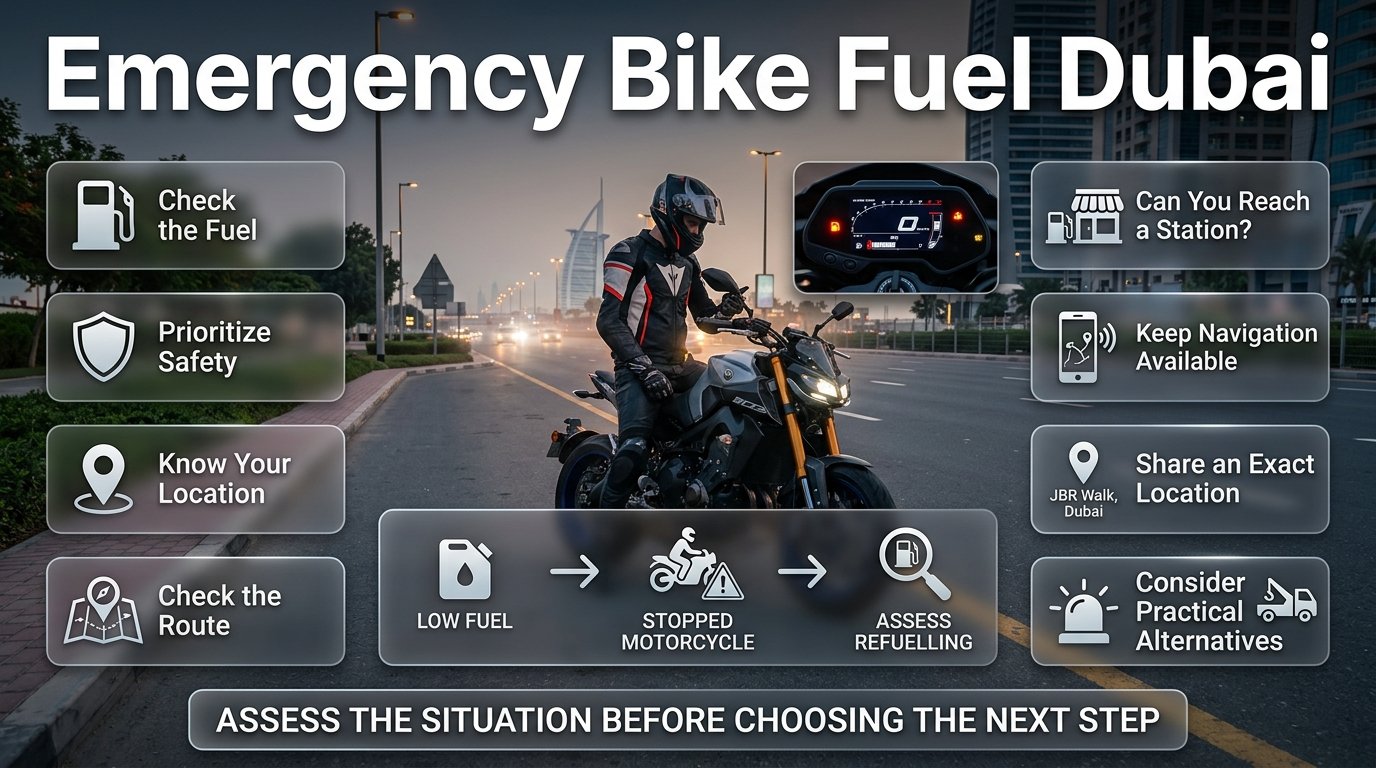
When a motorcycle runs out of fuel, the first step is to protect yourself from traffic rather than immediately focusing on getting petrol. Move the motorcycle to the safest practical position if you can do so without creating another danger, stay away from active traffic lanes, and assess your location before deciding what to do next.
An empty fuel tank is inconvenient, but standing in an unsafe position beside moving traffic can be far more serious.
Your first five actions
- Stay calm and stop unnecessary engine attempts.
- Move the motorcycle somewhere safer if practical.
- Identify your exact location.
- Check whether a petrol station is genuinely reachable.
- Choose the safest practical way to restore mobility.
Don’t immediately assume that the nearest petrol station shown on a map is the best option. Dubai roads can include divided carriageways, one-way systems, service roads, restricted turns, large intersections, and entrances that aren’t obvious from a simple map view.
💡 Pro Tip: When you’re dealing with a fuel emergency, think in terms of safe access, not just distance. A station that appears 1 kilometre away may be much harder to reach than one slightly farther away with a direct and practical route.
Why Do Motorcycle Fuel Emergencies Happen So Easily?
Motorcycle fuel emergencies usually aren’t caused by one single problem. In many cases, the rider simply misjudges how much fuel remains or how much will be consumed during the journey.
A motorcycle can use fuel differently depending on its engine, riding conditions, traffic, load, maintenance, riding style, and route.
Common reasons include:
- Forgetting to refuel before a long ride
- Ignoring the low-fuel warning
- Assuming the reserve will last longer than it does
- Heavy traffic and frequent stopping
- Repeated delivery trips
- Taking an unexpected detour
- Travelling through unfamiliar areas
- Misreading the fuel gauge
- Higher-than-normal fuel consumption
- Delaying refuelling because a station seems “close enough”
The problem becomes more serious when the rider continues travelling after the warning appears without knowing the motorcycle’s realistic remaining range.
A fuel gauge isn’t a guarantee of distance. It’s an indication that should be interpreted together with your motorcycle’s normal fuel consumption and current riding conditions.
How Do You Know Whether You Can Still Reach a Petrol Station?
The answer depends on the amount of fuel remaining, the motorcycle, road conditions, and the actual route to the station.
If the motorcycle is still running and you know a suitable petrol station is genuinely nearby, refuelling there may be the simplest option. But if the engine has already stopped, the calculation changes completely.
Consider these questions
- Is the motorcycle still running?
- Is the fuel warning already showing?
- How far away is the station by an actual road route?
- Are there barriers or divided roads?
- Is the route safe for a motorcycle?
- Would pushing the motorcycle be practical?
- Are you in a parking area or on a live road?
- Is the weather making movement difficult?
- Do you know the area well?
| Situation | Practical decision |
|---|---|
| Bike is running and station is genuinely close | Refuel as soon as practical |
| Bike is running but station is uncertain | Don’t gamble on remaining range |
| Bike has stopped completely | Consider an appropriate emergency option |
| Bike is on a busy road | Prioritise personal safety |
| Bike is inside a parking facility | Provide exact access information |
| Rider is unfamiliar with the area | Confirm location before moving |
Don’t rely on the last few kilometres
Riders sometimes think, “I only need to go a little farther.”
That approach can work sometimes, but it’s risky because fuel consumption isn’t perfectly predictable.
Traffic may become heavier. You may miss a turn. The station may be on the opposite side of a divided road. You may discover that a road doesn’t provide the expected access.
⚠ Common Mistake: Treating the estimated remaining range as an exact promise. Your motorcycle’s actual range can change with traffic, riding style, load, road conditions, and mechanical condition.
What Information Should You Give During an Emergency Fuel Situation?
Once you decide that you need assistance, accurate location information becomes extremely important.
Saying “I’m in Dubai” isn’t enough. Even saying “I’m in Jumeirah” or “I’m in Al Barsha” may not identify the motorcycle precisely enough.
A useful location description should include as much of the following as possible:
- Area or community
- Road name
- Building name
- Nearby landmark
- Direction of travel
- Parking facility
- Parking floor
- Parking section
- Bay number
- Entrance or exit
- Any visible road sign
For example:
“My motorcycle is in Al Barsha, inside the parking area of a residential building, Level P2, near the main entrance.”
That’s much more useful than:
“I’m in Al Barsha and need petrol.”
If you’re on a road
Provide:
- Road name if visible
- Nearest exit
- Nearby building or landmark
- Direction you’re travelling
- Whether the motorcycle is safely off the traffic lane
If you’re in a parking facility
Provide:
- Building or property name
- Parking level
- Zone
- Bay number
- Nearest entrance
- Security/access information
📌 Quick Tip: Before contacting anyone, look around for a road sign, building name, parking marker, or visible landmark. One accurate detail can eliminate a lot of confusion.
What Is the Difference Between Emergency Bike Fuel and Normal Refuelling?
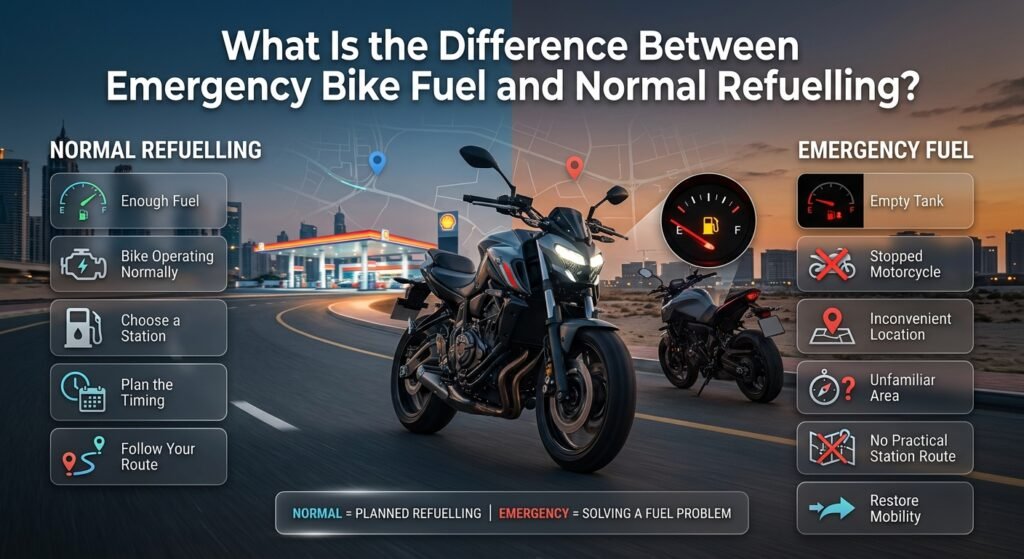
Normal refuelling is planned. Emergency fuel is about solving a problem after normal planning has failed.
When your motorcycle is operating normally, you can select a petrol station based on your route and refuel before the tank becomes critically low.
An emergency situation is different.
The motorcycle may already be stationary, and your options become limited.
Normal refuelling
Normal refuelling usually means:
- You have enough fuel to travel.
- The motorcycle is functioning normally.
- You can choose a convenient petrol station.
- You can plan the timing.
- You don’t need immediate roadside assistance.
Emergency fuel situation
An emergency may involve:
- An empty tank
- A stopped motorcycle
- An inconvenient location
- An unfamiliar area
- No practical route to a station
- A need to restore mobility quickly
The goal in an emergency isn’t necessarily to fill the entire tank immediately. The first objective is to restore enough mobility to get the motorcycle to a suitable refuelling point when appropriate.
When Is Petrol Delivery Relevant to a Bike Fuel Emergency?
Petrol Delivery Dubai is a broader topic covering situations where fuel needs to reach a vehicle rather than the vehicle travelling to a petrol station.
For a motorcycle rider, the idea becomes relevant when the bike cannot reasonably reach a station under its own power.
For example, imagine a rider finishes a late delivery and discovers that the motorcycle has completely run out of petrol in an unfamiliar part of Dubai.
The nearest suitable station may be too far to push the bike safely.
In that situation, the rider needs to think about:
- Personal safety
- Motorcycle location
- Correct fuel type
- Accessibility
- Appropriate fuel assistance
- What happens after the bike starts again
The decision should always be based on the actual situation rather than simply choosing the first option that appears in a search.
How Is an Emergency Bike Fuel Situation Different From Car Fuel Delivery?
A motorcycle isn’t simply a smaller car.
It has a different fuel tank, different physical structure, different rider exposure, and different roadside risks.
For a comparison with the car-specific topic, Car Petrol Delivery Dubai covers situations involving cars.
Key differences
| Factor | Motorcycle | Car |
|---|---|---|
| Rider protection | Limited | Greater physical protection |
| Fuel tank | Generally smaller | Generally larger |
| Roadside exposure | Higher | Lower |
| Parking footprint | Smaller | Larger |
| Pushing difficulty | Can be manageable briefly | Usually impractical |
| Rider vulnerability | Higher | Lower |
| Exact vehicle identification | Important | Important |
The biggest difference is safety.
A rider standing beside a motorcycle on an active road is much more exposed than someone sitting inside a vehicle.
That means a fuel emergency should never be treated as merely a minor inconvenience.
What Should You Do If Your Motorcycle Stops on a Busy Road?
A motorcycle that suddenly loses power on a busy road can create an immediate safety concern.
Don’t focus entirely on finding petrol while ignoring surrounding traffic.
If it is safe and physically practical, move the motorcycle away from active traffic. Avoid making sudden movements across lanes just to reach a roadside position.
Once you’re in a safer location:
- Stay alert to surrounding traffic.
- Keep yourself visible.
- Avoid standing unnecessarily close to moving vehicles.
- Don’t attempt unsafe repairs.
- Identify your exact location.
- Decide whether the bike can realistically reach a station.
- Seek appropriate assistance if necessary.
For delivery riders, road safety deserves particular attention because motorcycles spend significant amounts of time on Dubai roads.
Riders should also follow applicable traffic requirements and safe riding practices rather than trying to save a few minutes during a fuel emergency.
⭐ Expert Tip: If your motorcycle has stopped in an exposed position, treat the situation as a roadside safety issue first and fuel problem second.
What If the Motorcycle Is in a Parking Area?
A parking area can make a fuel emergency easier in one sense because you may be away from moving traffic. However, precise location information becomes especially important.
Large malls, hotels, residential buildings, office towers, and mixed-use properties can have multiple parking floors and entrances.
If you’re in a parking facility, identify:
- Property name
- Parking floor
- Zone
- Bay number
- Entrance
- Nearby lift
- Nearby landmark
- Whether external access is permitted
For example:
“Dubai Mall, parking area, Level 2, Zone C, near the east-side entrance.”
is far more useful than:
“I’m at Dubai Mall.”
Check property access rules
Some parking facilities have their own security and access procedures.
If someone needs to reach the motorcycle, make sure you understand whether outside vehicles can enter the relevant area.
⚠ Common Mistake: Giving only the name of the building. Large properties can have several entrances and multiple parking sections.
Can You Push a Motorcycle to a Petrol Station?
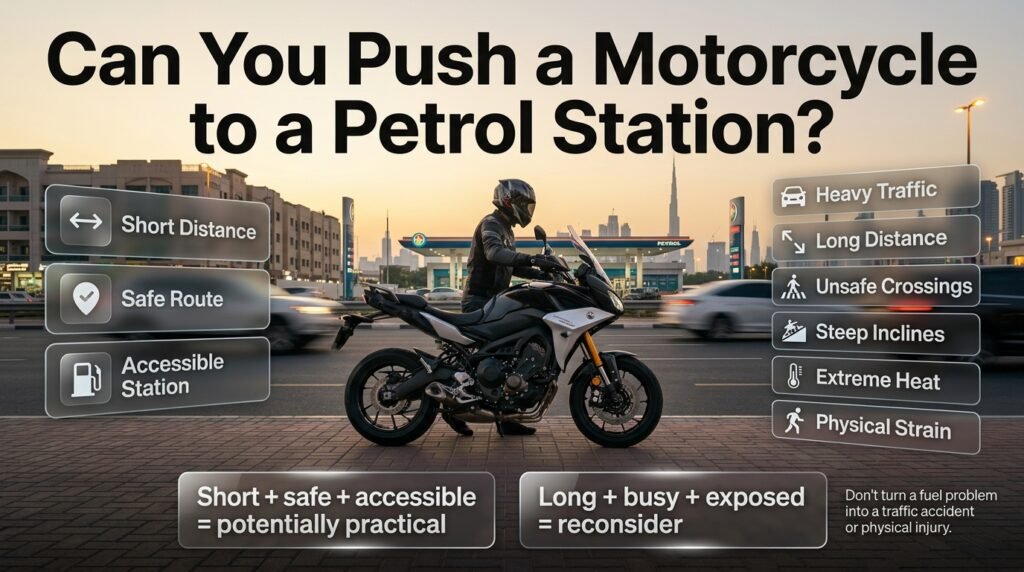
Sometimes, but only when the distance and route are genuinely safe and manageable.
A motorcycle can be easier to push than a car, but that doesn’t mean it should be pushed over a long distance.
Consider:
- Distance
- Road surface
- Traffic
- Temperature
- Inclines
- Pedestrian areas
- Road crossings
- Your physical condition
- Whether you can control the motorcycle safely
If the station is just around the corner and the route is safe, pushing may be practical.
If it requires crossing major roads, walking beside heavy traffic, or pushing for a long distance, the risk may outweigh the benefit.
A simple decision
Short + safe + accessible = potentially practical
Long + busy + exposed = reconsider
Don’t turn a fuel problem into a traffic accident or physical injury.
What If You Search for Bike Petrol Refill Near Me?
If your motorcycle is still running and you simply want to find a nearby place to refuel, Bike Petrol Refill Near Me Dubai addresses a different search intent.
This distinction is important.
Someone searching for “bike petrol refill near me” may be looking for a nearby station.
Someone searching for “emergency bike fuel Dubai” may already be stranded.
The two situations should not be confused
| Search intent | Main problem |
|---|---|
| Bike petrol refill near me | Where can I refuel nearby? |
| Emergency bike fuel Dubai | What can I do because my motorcycle can’t continue? |
If your motorcycle is running normally, finding a suitable station is generally straightforward.
If the motorcycle has completely stopped, your priority shifts toward safety, location accuracy, and restoring mobility.
What Is Bike Petrol Delivery Used For?
Bike Petrol Delivery Dubai has a more specific focus on delivering petrol to a motorcycle.
This is distinct from the broader emergency-fuel topic because the vehicle itself is now clearly identified as a bike.
That matters when explaining your situation because motorcycles can have different requirements from cars.
Before seeking any appropriate fuel option, be prepared to provide:
- Motorcycle type
- Fuel requirement
- Exact location
- Whether the engine has completely stopped
- Whether the motorcycle is parked or roadside
- Whether the location has access restrictions
This information helps prevent confusion and makes the request more specific.
What Is Motorcycle Fuel Delivery in Dubai?
Motorcycle Fuel Delivery Dubai focuses specifically on the motorcycle fuel-delivery search rather than general vehicle fuel problems.
The distinction may seem small, but it matters for search intent and for the rider.
A motorcycle rider may be dealing with:
- A smaller tank
- A different fuel-system layout
- A motorcycle-specific fuel requirement
- A parking-area access issue
- Greater exposure to roadside traffic
When communicating the situation, don’t simply say “vehicle.”
Say that you’re dealing with a motorcycle and explain what has happened.
That one clarification can prevent the wrong assumptions.
How Much Fuel Does a Motorcycle Need During an Emergency?
There isn’t one universal amount that applies to every motorcycle.
The appropriate quantity depends on the motorcycle’s tank capacity, fuel system, remaining fuel, distance to a suitable station, and manufacturer’s requirements.
The purpose of emergency fuel should generally be to restore mobility safely rather than making assumptions about a universal quantity.
Before adding fuel, confirm:
- Correct fuel type
- Motorcycle requirements
- Tank capacity
- Whether any fuel remains
- Whether there is a visible leak
- Whether the motorcycle is safely positioned
Never continue adding fuel beyond the motorcycle’s specified tank capacity.
And never treat fuel handling casually.
Petrol is highly flammable, so avoid smoking, flames, sparks, and unnecessary ignition sources around fuel.
What Fuel Type Should You Put in a Motorcycle?
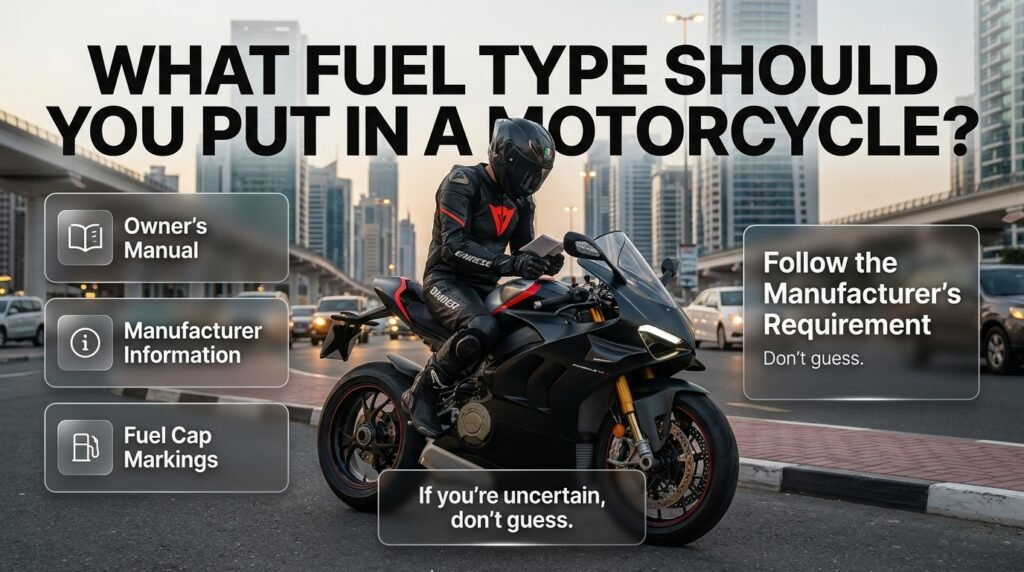
Always follow the motorcycle manufacturer’s specified fuel requirement.
Don’t select a fuel grade simply because another rider uses it.
The correct information can normally be found through:
- Owner’s manual
- Manufacturer information
- Fuel label or cap markings
- Authoritative vehicle documentation
If you’re uncertain, don’t guess.
Using the wrong fuel can create a mechanical problem on top of the original fuel emergency.
What if you aren’t sure?
Tell the person assisting you that you’re unsure rather than making an assumption.
Provide the motorcycle make and model where possible and verify the recommended fuel specification before refuelling.
📌 Quick Tip: Knowing your motorcycle’s required fuel type before an emergency happens is one of the easiest pieces of preparation you can do.
What Should You Do After Fuel Is Added?
Getting fuel into the motorcycle doesn’t automatically mean the situation is completely solved.
After refuelling:
- Make sure the fuel cap is properly closed.
- Check for obvious spills or leakage.
- Start the motorcycle according to the manufacturer’s normal procedure.
- Allow the engine to operate normally.
- Confirm that the motorcycle is running properly.
- Travel to a suitable petrol station if necessary.
- Don’t immediately ride aggressively after a stressful roadside stop.
If the motorcycle still doesn’t start after receiving the correct fuel, don’t automatically assume that more fuel will solve the problem.
The original problem may have another cause.
For example:
- Battery issue
- Mechanical fault
- Electrical problem
- Fuel-system problem
- Ignition problem
At that point, the situation has moved beyond a simple empty-tank problem.
What Are the Most Common Emergency Fuel Mistakes?
Fuel emergencies often become worse because riders make decisions under pressure.
Mistake 1: Ignoring the warning
A low-fuel warning isn’t something to postpone indefinitely.
Why it happens: The rider believes there is still enough reserve.
Why it’s risky: The remaining range can be uncertain.
Better approach: Plan to refuel promptly.
Mistake 2: Driving until the motorcycle completely stops
Why it happens: The rider wants to reach one more destination.
Why it’s risky: You lose the ability to choose where the motorcycle stops.
Better approach: Refuel before the situation becomes critical.
Mistake 3: Pushing too far
Why it happens: The rider sees a station on the map.
Why it’s risky: The route may be longer or less safe than expected.
Better approach: Consider the actual road route and conditions.
Mistake 4: Standing beside moving traffic
Why it happens: The rider is focused on solving the fuel issue.
Why it’s risky: Motorcycles offer little protection to the rider.
Better approach: Move to the safest practical position first.
Mistake 5: Giving vague location information
Why it happens: Stress makes people provide short descriptions.
Why it’s risky: Dubai has many roads and large properties with multiple entrances.
Better approach: Provide road, landmark, building, parking level, or map location details.
Mistake 6: Guessing the fuel type
Why it happens: The rider assumes all petrol is interchangeable.
Why it’s risky: The motorcycle’s manufacturer may specify a particular requirement.
Better approach: Verify before refuelling.
Mistake 7: Treating emergency fuel as normal fuel planning
Why it happens: Once the emergency is solved, the rider forgets about it.
Why it’s risky: The same situation can happen again.
Better approach: Identify why the tank became empty and change the refuelling routine.
How Can Delivery Riders Prevent Fuel Emergencies?
Delivery riders may face fuel emergencies more often than occasional riders because motorcycles can remain active for many hours.
A rider might start the shift with enough fuel but underestimate how much petrol will be consumed during repeated short trips.
One delivery may be close.
The next may be several kilometres away.
Then another order sends the rider in a different direction.
After hours of this, the original fuel estimate may no longer be accurate.
A better delivery-rider routine
Before starting:
- Check the fuel level.
- Consider the expected workload.
- Know where convenient refuelling opportunities are.
- Make sure the motorcycle is operating normally.
During the shift:
- Don’t ignore the low-fuel warning.
- Use appropriate breaks for refuelling.
- Pay attention to unusual fuel consumption.
- Don’t repeatedly delay refuelling.
Before a long run:
- Check whether enough fuel is available.
- Consider the likely route.
- Avoid assuming that the next station will always be convenient.
The goal is simple: don’t let the motorcycle choose where you stop.
What If You’re Delivering Orders When the Bike Runs Out of Fuel?
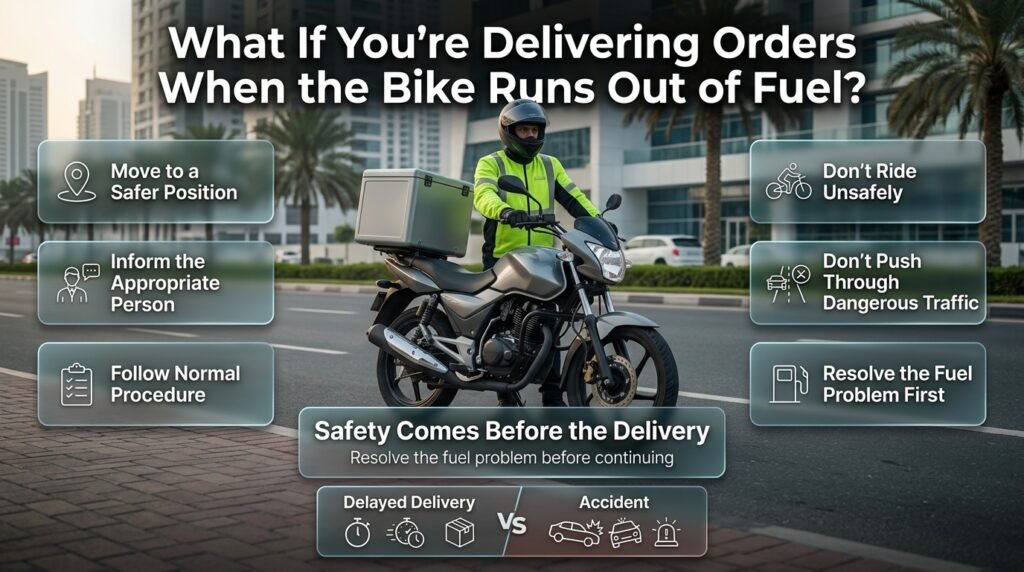
A delivery rider may feel pressure to continue because an order is waiting.
That’s understandable, but safety shouldn’t be sacrificed to save a few minutes.
If the motorcycle has run out of petrol:
- Get yourself into a safer position.
- Inform the appropriate person or employer according to your normal procedure.
- Don’t attempt unsafe riding.
- Don’t push the bike through dangerous traffic.
- Resolve the fuel problem before continuing.
A delayed delivery is frustrating.
An accident is much more serious.
How Does Dubai Traffic Affect a Motorcycle Fuel Emergency?
Dubai has a mixture of high-speed roads, residential streets, commercial areas, service roads, parking facilities, and busy intersections.
That means the consequences of running out of fuel can vary dramatically depending on where it happens.
A motorcycle that stops inside a quiet parking area presents a different situation from one that stops close to fast-moving traffic.
Location changes the priority
Residential street:
You may have more space to move the bike safely.
Shopping-centre parking:
You need accurate floor and zone information.
Business district:
Building access and traffic can become important.
Industrial area:
Distances between convenient facilities may be greater.
High-traffic road:
Personal safety becomes the immediate concern.
This is why a good emergency response starts with location assessment rather than immediately focusing on fuel quantity.
How Can You Prepare Before Riding Around Dubai?
Preparation doesn’t need to be complicated.
You can reduce the chance of a fuel emergency by creating a simple routine.
Before every longer ride
Check:
- Fuel level
- Tyres
- Lights
- Brakes
- Phone battery
- Navigation
- Expected route
For regular riders
Keep track of approximately how far your motorcycle normally travels on a tank.
You don’t need a perfect mathematical calculation.
You simply need a practical understanding of when your motorcycle normally requires refuelling.
For example, if you notice that your motorcycle becomes uncomfortable to rely on after a certain amount of riding, don’t consistently push beyond that point.
For delivery riders
Consider fuel as part of your shift planning.
Don’t wait until the bike is almost empty to think about where the next petrol station is.
What If the Fuel Gauge Seems Wrong?
A faulty or unreliable fuel gauge can make emergencies more likely.
If the gauge behaves strangely, don’t assume the motorcycle has more fuel than it actually does.
Warning signs may include:
- Fuel level changing unexpectedly
- Gauge staying full for too long
- Gauge dropping suddenly
- Warning light appearing unusually early
- Range estimate behaving inconsistently
If you notice a pattern, have the motorcycle checked appropriately rather than continuing to rely on an unreliable indication.
A fuel gauge problem is easy to ignore until the bike stops.
How Should You Handle Fuel During Hot Dubai Weather?
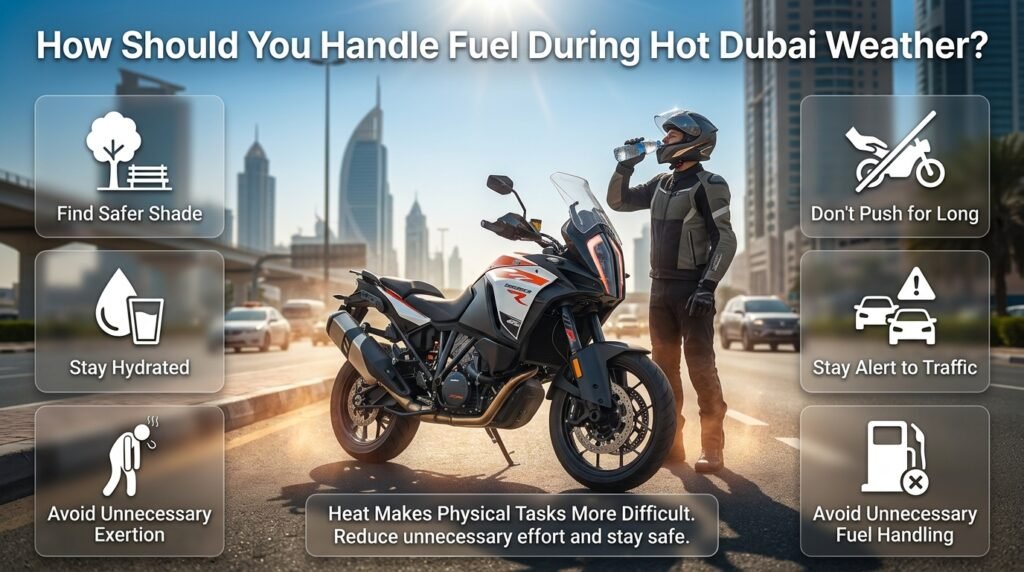
High temperatures can make a roadside fuel problem more uncomfortable and potentially more hazardous.
If you’re stranded:
- Look for a safer shaded position where possible.
- Keep yourself hydrated.
- Avoid unnecessary physical exertion.
- Don’t spend a long time pushing the motorcycle in difficult conditions.
- Stay alert to traffic.
- Avoid unnecessary fuel handling.
Heat can also make a simple physical task feel much more difficult than expected.
That is another reason why prevention is better than waiting until the tank is completely empty.
Should Emergency Bike Fuel Be Your Regular Refuelling Method?
No. Emergency fuel should generally be considered a backup option, not a replacement for normal fuel planning.
Routine refuelling gives you more control.
You can choose:
- When to stop
- Where to stop
- Which route to use
- How much fuel to add
- When to continue
An emergency removes many of those choices.
The best outcome is therefore not simply knowing how to solve a fuel emergency.
It’s reducing the chance of having one.
A practical mindset
Normal fuel level → Planned refuelling → Continue riding
instead of:
Low fuel → Ignore warning → Empty tank → Stress → Emergency solution
That small change in behaviour can make motorcycle riding much easier.
What Should You Do If the Motorcycle Doesn’t Start After Refuelling?
If the motorcycle has received the correct fuel but still won’t start, stop assuming that the tank was the only problem.
Check only the normal, safe things you are familiar with. Don’t attempt complicated roadside mechanical work if you aren’t trained to do it.
Possible causes can include:
- Battery failure
- Electrical fault
- Fuel-system problem
- Ignition issue
- Mechanical failure
At this stage, the correct solution may no longer be fuel.
Continuing to repeatedly operate the starter without understanding the problem may also drain the battery.
⭐ Expert Tip: If the motorcycle remains non-operational after the fuel issue has been addressed, treat it as a separate mechanical problem rather than continuing to add fuel.
What should I do if my motorcycle runs out of fuel in Dubai?
If your motorcycle runs out of fuel in Dubai, your first priority should be getting yourself and the bike into the safest practical position rather than immediately trying to reach a petrol station. A motorcycle rider is much more exposed to surrounding traffic, so standing on or close to a busy road can create a bigger problem than the empty tank itself. Once you’re in a safer location, identify your exact position and decide whether a nearby petrol station is realistically reachable or whether an emergency fuel option is more practical.
Important steps to follow:
Move away from active traffic where it is safe to do so.
Avoid repeatedly trying to start an empty fuel tank.
Check your exact road, area, landmark, or parking location.
Don’t push the motorcycle a long distance through heavy traffic.
Confirm the correct fuel requirement for your motorcycle.
Provide precise location information if you need assistance.
The key is to stay calm and avoid making a rushed decision. A station that appears close on a map may still be difficult to reach because of divided roads, traffic, restricted turns, or access issues.
Can I get emergency fuel for a motorcycle in Dubai?
Emergency fuel can be a practical option when a motorcycle has completely run out of petrol and cannot safely or conveniently reach a petrol station. The important point is to make sure the fuel option is suitable for a motorcycle, because the vehicle type, fuel requirement, location, and access conditions can affect how the situation needs to be handled.
When requesting appropriate assistance, don’t simply say that you need fuel in Dubai. Give enough information for the situation to be understood clearly.
Useful information includes:
Motorcycle make and model, if known
Required fuel type
Exact location
Road or street name
Nearby landmark
Building name if applicable
Parking floor or bay number
Whether the motorcycle has completely stopped
Any access restrictions at the location
For example, saying “my motorcycle is in Level P2 parking near the main entrance” is much more useful than simply saying “I’m near a mall.”
Emergency fuel should also be viewed as a backup solution. For regular riding, planned refuelling before the tank becomes critically low is normally a better approach.
Is it better to find a petrol station or use emergency bike fuel?
The better option depends on whether your motorcycle can safely reach a suitable petrol station. If the bike is still running normally and a station is genuinely nearby, normal refuelling is usually the simpler choice. If the motorcycle has completely stopped and the station isn’t realistically reachable, an appropriate emergency fuel solution may make more sense.
Don’t make the decision based only on the distance shown on a map. Consider the actual road route and your current surroundings.
Use these questions to decide:
Is the motorcycle still running?
How far is the station by road?
Is the route safe?
Are there divided roads or difficult crossings?
Would pushing the bike be practical?
Are you in a parking area or roadside?
Is the location unfamiliar?
If the answer to several of these questions raises concerns, trying to reach a distant station may not be worth the risk.
The purpose of emergency fuel isn’t to replace normal petrol stations. It’s to provide a practical alternative when the motorcycle has already lost the ability to reach one conveniently.
How can delivery riders avoid running out of fuel in Dubai?
Delivery riders should treat fuel planning as part of their daily work routine because motorcycles used for deliveries can cover significant distances during a single shift. Multiple short trips can also consume more fuel than expected, especially when traffic, waiting time, detours, and repeated acceleration are involved.
A rider shouldn’t wait until the fuel gauge is almost empty before thinking about the next refuelling opportunity.
A practical routine includes:
Check the fuel level before starting the shift.
Refuel before reaching a critically low level.
Pay attention to the motorcycle’s normal fuel consumption.
Use suitable breaks to refuel.
Don’t ignore a low-fuel warning.
Consider the expected distance of the day’s deliveries.
Know convenient refuelling points along regular routes.
Keep your phone charged in case you need navigation or assistance.
For example, if a rider normally completes several deliveries around different parts of Dubai, starting with just enough petrol for the first few trips can create unnecessary risk. A little planning at the beginning of the shift can prevent being stranded later.
The best strategy is simple: don’t let the motorcycle decide where you have to stop for fuel.
What information should I provide when requesting emergency bike fuel in Dubai?
The most useful information is your exact location, motorcycle type, and fuel requirement. During a fuel emergency, vague information can cause unnecessary delays because Dubai contains large communities, multiple roads, parking structures, and properties with several entrances.
Start with your area and then make the location more specific.
Try to provide:
Area or community name
Road or street name
Nearby landmark
Building or property name
Direction of travel if you’re roadside
Parking level if you’re inside a building
Parking section or zone
Bay number where available
Motorcycle make and model
Correct petrol requirement
Whether the motorcycle has completely stopped
For a parking facility, a description such as “Level 2, Zone C, near the east entrance” is much more useful than simply giving the name of the building.
Also explain whether the motorcycle is on a public road, residential street, parking area, or another location with access restrictions. This gives a much clearer picture of the situation and helps you choose the most appropriate next step.
Most importantly, don’t put yourself in danger just to provide a more precise location. If you’re in an unsafe roadside position, move to safety first whenever it is possible to do so.
Conclusion
Running out of fuel on a motorcycle in Dubai can be stressful, especially when you’re far from a petrol station or stopped in an unfamiliar area. However, the situation becomes much easier to manage when you focus on the right priorities: safety, accurate location, correct fuel information, and a practical solution.
If your motorcycle has completely run out of petrol, don’t take unnecessary risks by riding with almost no fuel or pushing the bike through heavy traffic. First move to the safest practical position, identify exactly where you are, and then decide whether reaching a petrol station is realistic or whether an emergency fuel option is more suitable.
For regular riders and delivery riders, prevention is even better. Check your fuel before longer journeys, don’t ignore low-fuel warnings, understand your motorcycle’s normal fuel consumption, and refuel before the tank reaches a critical level.
The main lesson is simple: emergency bike fuel should be a backup, not part of your normal riding routine. With better fuel planning and a calm response when problems occur, you can reduce the chances of becoming stranded and handle an unexpected fuel emergency more safely and confidently.
Leave a Reply