Intoduction
Petrol Delivery for Cars in Dubai | Running out of petrol is a problem most drivers don’t expect until it actually happens. You may be travelling across Dubai, leaving work, driving home, heading to a meeting, or simply parking your car when you suddenly notice that the fuel warning has been on for longer than expected.
Then the car starts losing power.
You check the gauge again.
There isn’t enough fuel to reach a petrol station.
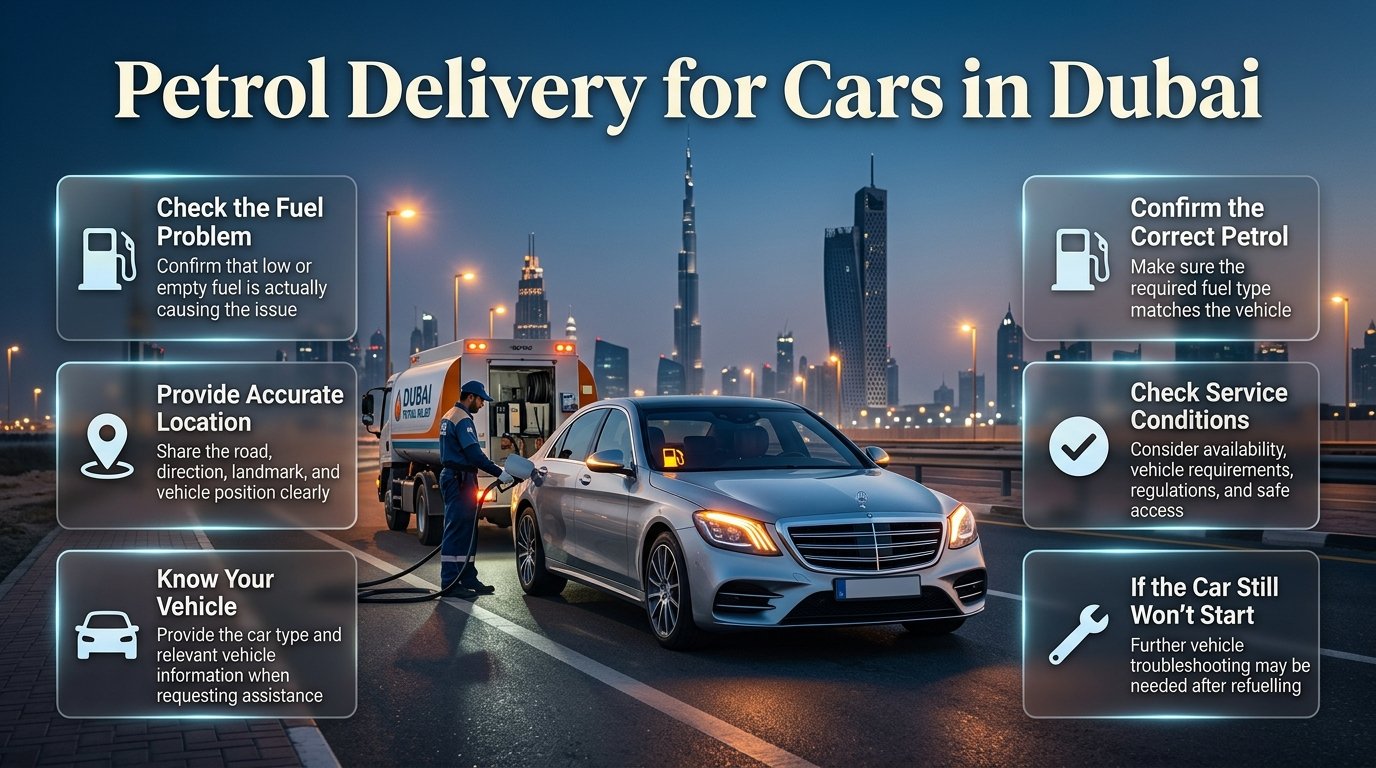
This is exactly where petrol delivery for cars can become a practical option. Instead of trying to move a vehicle that has little or no fuel, a suitable fuel-delivery service may be able to bring the required petrol to the vehicle’s location, subject to service availability, regulations, vehicle requirements, and safe access.
For general petrol-station information in Dubai, you can also visit PetrolStationNearMeDubai.
But petrol delivery isn’t simply about ordering petrol and waiting for someone to arrive. Drivers need to know what information to provide, which fuel their car requires, how much fuel may be practical, what to check before confirming a service, and what to do if the vehicle still doesn’t start after refuelling.
This guide covers all of those questions in one place.
What Is Petrol Delivery for Cars?
Petrol delivery for cars is a fuel-assistance service designed to bring petrol to a vehicle instead of requiring the driver to take the vehicle to a petrol station first. Depending on the provider and applicable approvals, the service may be arranged through a phone call, website, messaging platform, or mobile application.
The main idea is simple:
Car cannot conveniently reach a petrol station → fuel is requested → location and vehicle details are confirmed → suitable fuel assistance is arranged → the vehicle receives fuel at its location.
In Dubai, fuel delivery and vehicle refuelling is a regulated commercial activity, and the Dubai Roads and Transport Authority has specific requirements covering specialised vehicles, permits, technical standards, safety requirements, and the handling of petroleum products.
That means drivers shouldn’t treat every online fuel-delivery advertisement as automatically authorised or suitable.
A responsible driver should confirm that the service is legitimate, currently available, appropriate for the vehicle, and able to operate safely at the requested location.
Why Do Drivers Search for Car Petrol Delivery?
The reason is usually practical rather than complicated.
A driver may have:
- Completely run out of petrol.
- Very little fuel and no practical route to a station.
- A vehicle parked somewhere inconvenient.
- A car that stopped because the tank became empty.
- A vehicle stranded on a road or in another accessible location.
- Difficulty reaching a station because of the vehicle’s position.
- An urgent need to get enough fuel to continue to a suitable petrol station.
The important distinction is that fuel delivery addresses a fuel-access problem.
It doesn’t automatically repair a dead battery, damaged starter, electrical fault, engine problem, tyre issue, or other mechanical failure.
When Does Petrol Delivery for Cars Make Sense?
Petrol delivery is most useful when the car cannot reasonably get to a petrol station because there isn’t enough fuel to drive there.
Imagine a driver travelling through Dubai during heavy traffic. The fuel warning appears, but the driver assumes there is still enough petrol for a few more kilometres.
Traffic becomes slower.
The next petrol station is farther away than expected.
Eventually, the engine loses power and the vehicle stops.
At that point, asking the driver to simply “go to the petrol station” isn’t practical because the vehicle can’t move.
Fuel delivery may provide a solution if an appropriate service is available.
Situations Where It Can Be Useful
A car fuel-delivery option may make sense when:
- The vehicle has completely run out of petrol.
- The nearest petrol station is too far to reach.
- The vehicle is parked in a location where getting fuel separately is inconvenient.
- The driver doesn’t have a practical way to transport fuel safely.
- The vehicle needs enough fuel to become mobile again.
- The driver is unfamiliar with the surrounding area.
However, if the car is already safely parked and a petrol station is only a short distance away, travelling to the station may remain the simpler option.
Petrol Delivery for Cars vs Going to a Petrol Station
These two options solve the same basic need—getting petrol—but they work differently.
| Situation | Petrol Delivery | Petrol Station |
|---|---|---|
| Car has completely run out | Practical if available | Vehicle may not be able to reach it |
| Station is nearby | May be unnecessary | Usually simpler |
| Car is safely parked at home | Convenient in suitable circumstances | Requires another trip |
| Vehicle is stranded roadside | Potentially useful | May be difficult to reach |
| Full tank needed | Depends on provider | Usually straightforward |
| Mechanical fault exists | Fuel may not solve it | Professional help may still be needed |
| Immediate roadside problem | Can address fuel shortage | Driver still has to reach station |
The best choice isn’t always the one that sounds fastest.
The right question is:
Can the car safely reach a petrol station under its own power?
If the answer is yes, driving to the station may be easiest.
If the answer is no because the tank is empty, fuel assistance becomes more relevant.
For drivers who are able to reach a station but aren’t sure where the nearest one is, the Nearest Petrol Station Dubai guide can be useful.
How Does Petrol Delivery for Cars Work?
The exact process depends on the provider, but a typical request follows several basic stages.
Step 1: Confirm the Fuel Problem
Before contacting anyone, check whether the vehicle genuinely appears to have run out of petrol.
Look at:
- Fuel gauge.
- Low-fuel warning.
- Recent driving distance.
- Engine behaviour before stopping.
- Any warning lights.
- Whether the vehicle was already experiencing another problem.
If the fuel gauge shows a reasonable level and the car suddenly stopped, don’t automatically assume that adding petrol will solve the issue.
Step 2: Identify Your Vehicle
Tell the provider what type of vehicle you have.
For example:
- Sedan
- Hatchback
- SUV
- 4×4
- Luxury car
- Hybrid vehicle
- Other passenger vehicle
Vehicle information can help the provider understand what type of assistance is being requested.
Step 3: Confirm the Fuel Type
This is one of the most important parts of the request.
Never guess.
If you’re unsure, check the vehicle manufacturer’s information, fuel-filler label, owner’s manual, or another reliable source.
Incorrect fuelling can create a much bigger problem than simply running out of petrol.
Step 4: Share Your Exact Location
A general location such as “Dubai Marina” may not be enough.
A better location description includes:
- Road name.
- Direction of travel.
- Nearby building.
- Landmark.
- Exit or junction.
- Parking area.
- Exact roadside position.
- Live location, where appropriate.
The more precise the location, the easier it can be to understand where assistance is required.
Step 5: Ask About Price and Availability
Before confirming the request, clarify:
- Fuel price.
- Service fee.
- Delivery fee.
- Total expected price.
- Fuel quantity.
- Current availability.
- Payment method.
- Any minimum order requirement.
Don’t assume that the advertised fuel price is automatically the complete service price.
Step 6: Wait in a Safe Position
If you’re on a busy road, your safety matters more than getting the fuel delivered quickly.
Where possible and safe, move the vehicle away from active traffic.
If moving the vehicle would create additional danger, don’t take unnecessary risks.
What Information Should You Give When Ordering Petrol for a Car?
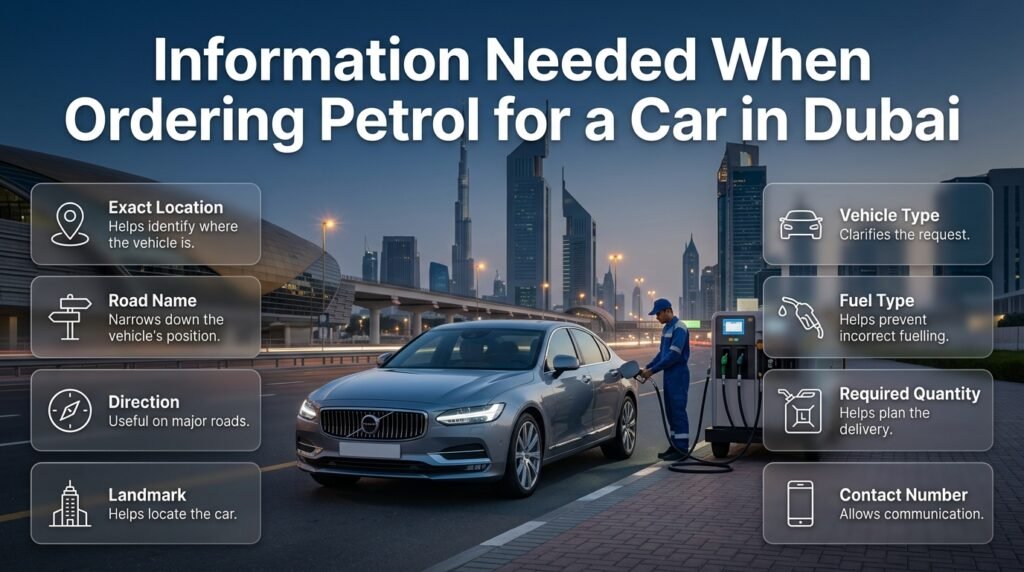
A good fuel-delivery request is specific.
Instead of saying:
“My car has no petrol. I’m in Dubai.”
give useful details such as:
“My sedan has run out of petrol near [road/landmark]. The vehicle is currently in [safe location]. I need petrol for the car and can provide the exact location.”
Useful information includes:
| Detail | Purpose |
|---|---|
| Exact location | Helps identify the vehicle |
| Road name | Narrows down the position |
| Direction | Useful on major roads |
| Landmark | Helps locate the car |
| Vehicle type | Clarifies the request |
| Fuel type | Prevents incorrect fuelling |
| Required quantity | Helps plan the delivery |
| Contact number | Allows communication |
Why Location Accuracy Matters
Dubai has major roads, multiple exits, large communities, parking structures, service roads, and interconnected areas.
Saying “I’m near Downtown” doesn’t necessarily tell someone where the vehicle is.
A location pin combined with a road name or landmark is much more useful.
💡 Pro Tip: Before contacting a fuel provider, open your map and identify the road, direction, and nearest recognisable landmark. It takes less than a minute and can make the request much clearer.
How Much Petrol Does a Car Need When It Runs Out?
There isn’t one correct quantity for every car.
The practical amount depends on:
- Vehicle fuel consumption.
- Distance to the nearest suitable station.
- Tank size.
- Current location.
- Traffic conditions.
- Provider availability.
- Whether the goal is simply to restart the vehicle or continue for a longer distance.
For many emergency situations, the objective is not necessarily to fill the entire tank.
The immediate goal may simply be to restore enough fuel for the vehicle to become mobile and reach a proper fuelling location.
However, the exact amount available through a delivery service can vary.
Should You Request a Full Tank?
Not automatically.
If you’re stranded two kilometres from a station, you may not need a full tank.
If you’re in a remote location, the practical amount may be different.
Before ordering, explain your circumstances and ask what quantity is available and appropriate.
⭐ Expert Tip: Think about the next safe destination rather than simply asking for “as much as possible.” The right quantity depends on where you need the car to go after the delivery.
Can Petrol Be Delivered to Different Types of Cars?
The answer depends on the service, but the general requirement is to identify the vehicle correctly before arranging fuel.
Petrol Delivery for Sedans
Sedans are common passenger vehicles and usually have straightforward petrol requirements.
When requesting fuel, provide the vehicle’s fuel type and location rather than assuming the provider already knows which petrol grade your vehicle needs.
Petrol Delivery for SUVs
SUVs may have larger fuel tanks than smaller cars, but a larger tank doesn’t automatically mean the delivery service will provide a large quantity.
Ask about available quantities before confirming.
Petrol Delivery for Hatchbacks
A hatchback may need less fuel to reach a nearby station because of its tank size and fuel consumption, but the required quantity still depends on the route and vehicle.
Petrol Delivery for Luxury Cars
Luxury and high-performance vehicles can have specific fuel requirements.
Always follow the fuel grade recommended by the manufacturer.
Petrol Delivery for Hybrid Cars
Hybrid vehicles require additional care because they combine an internal-combustion engine with an electric system.
If a hybrid car stops, don’t automatically assume that petrol is the only issue.
Tell the provider that the vehicle is a hybrid and explain what happened.
What Should You Do If Your Car Runs Out of Petrol on a Busy Road?
Running out of fuel on a busy road is different from running out of fuel in a quiet parking area.
The first priority should be personal and traffic safety.
If the vehicle can be moved safely away from active traffic, do so.
If it cannot be moved, make the vehicle as visible as reasonably possible and avoid standing in dangerous areas.
A Practical Response
- Turn on hazard lights where appropriate.
- Move the vehicle to a safer position if this can be done safely.
- Avoid standing in an active traffic lane.
- Identify the exact location.
- Contact appropriate assistance.
- Explain that the vehicle has run out of petrol.
- Provide the vehicle type and fuel information.
- Follow safety instructions while waiting.
If the vehicle is creating an immediate hazard or there is an accident or injury, appropriate emergency authorities should take priority.
⚠ Common Mistake: Drivers sometimes become so focused on finding fuel that they stand beside a stopped vehicle close to moving traffic. Don’t trade a fuel problem for a personal-safety risk.
Is Petrol Delivery Safe for Cars?
Safety depends heavily on how fuel is transported, handled, and transferred.
Petrol is highly flammable, so this isn’t an area where informal arrangements should be treated casually.
Dubai’s RTA requirements for fuel delivery and vehicle refuelling include specialised vehicles, technical requirements, safety conditions, appropriate approvals, and requirements concerning the transportation and handling of petroleum products.
This is one reason drivers should be careful when choosing a fuel-delivery provider.
What Should You Look For?
Before arranging fuel assistance, consider:
- Whether the provider appears to operate through an appropriate business arrangement.
- Whether the service is legally authorised where required.
- Whether appropriate fuel-handling equipment is used.
- Whether the provider can explain the fuel type being supplied.
- Whether the vehicle can safely be accessed.
- Whether the price and service conditions are clear.
Avoid informal fuel arrangements that involve unsafe storage, unknown containers, or unclear handling procedures.
Why Proper Equipment Matters
Fuel transportation isn’t the same as carrying a normal liquid.
A proper service needs to account for:
- Leakage.
- Spillage.
- Ignition risks.
- Safe transportation.
- Appropriate containers.
- Vehicle compatibility.
- Safe transfer procedures.
That is why professional fuel delivery should be treated as a specialised activity rather than a simple “bring me some petrol” request.
What Are the Main Benefits of Petrol Delivery for Cars?
Convenience
You don’t necessarily have to get the vehicle to a station first.
Useful When the Vehicle Cannot Move
This is perhaps the biggest practical benefit.
A car with an empty tank cannot drive to the station under its own power.
Helpful in Unfamiliar Areas
Drivers unfamiliar with Dubai may not know the closest appropriate station.
Saves Time in Some Situations
Instead of leaving the vehicle and trying to arrange another method of transporting fuel, an available delivery service may come directly to the vehicle.
Useful Outside Normal Travel Plans
Fuel emergencies don’t always happen near a convenient petrol station.
A delivery option can provide another route to solving the immediate fuel problem.
What Are the Limitations?
Petrol delivery isn’t a perfect solution.
Service Availability Varies
A provider may not operate in every location or at every time.
Coverage May Differ
Being somewhere in Dubai doesn’t automatically mean a particular provider serves that exact location.
Additional Charges May Apply
The final cost may include more than the fuel itself.
Fuel Doesn’t Repair a Broken Car
If the real issue is mechanical or electrical, additional petrol won’t solve it.
Access Can Be Difficult
A vehicle inside a restricted area, unsuitable parking structure, or dangerous roadside position may require different assistance.
What Should You Check Before Choosing a Petrol Delivery Service?
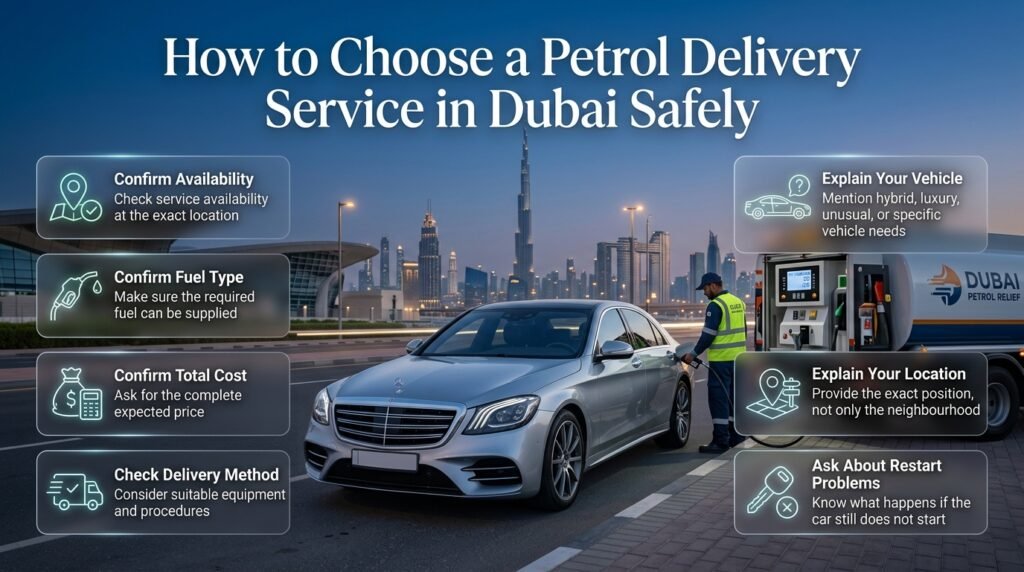
If you have multiple options, don’t choose only because one result appears first online.
1. Confirm Availability
Ask whether service is currently available at your exact location.
2. Confirm Fuel Type
Make sure the provider can supply the fuel your vehicle requires.
3. Confirm the Total Cost
Ask for the complete expected price before confirming.
4. Check the Delivery Method
Fuel should be transported and handled using suitable equipment and procedures.
5. Explain Your Vehicle
Mention if you have a hybrid, luxury vehicle, unusual vehicle, or another vehicle with specific requirements.
6. Explain the Location
Don’t assume that the provider can infer your exact position from the neighbourhood name.
7. Ask What Happens If the Car Doesn’t Start
This is a useful question before the delivery.
If the vehicle remains unable to start after receiving the correct fuel, you may need another form of roadside assistance.
Petrol Delivery for Cars in Different Dubai Areas
The practical need for fuel assistance can arise in many parts of Dubai.
Dubai Marina
A driver may run low on fuel while travelling through busy roads or residential and commercial areas.
Downtown Dubai
Heavy traffic and complex road layouts can make an unexpected fuel problem stressful, particularly when the vehicle cannot continue.
Deira
Older and busy road networks can present different challenges for a stranded vehicle, making accurate location information particularly useful.
Al Barsha
Drivers travelling between residential, commercial, and highway routes may find themselves farther from a suitable station than expected.
Business Bay
A driver may be close to major roads but still unable to reach a station after completely running out of fuel.
Jumeirah
Residential streets and local roads can create a different situation from highway breakdowns.
Dubai Silicon Oasis
Longer drives between different communities mean drivers should avoid relying too heavily on a low fuel warning.
Al Quoz
Industrial and commercial areas may have different access and stopping conditions, so exact location information matters.
The important point is that area names should not be treated as automatic service guarantees. Always confirm current availability with the provider.
What If You Run Out of Petrol in a Parking Area?
A parking area can be easier than a busy highway, but there are still practical considerations.
First, identify exactly where the vehicle is parked.
For example:
- Building name.
- Parking level.
- Section.
- Space number.
- Entrance.
- Nearby landmark.
If the car is in an underground parking area, tell the provider before they arrive.
Vehicle access can differ depending on:
- Height restrictions.
- Ramp access.
- Security controls.
- Parking rules.
- Fuel-handling restrictions.
A clear location description helps avoid unnecessary delays.
What If Your Car Runs Out of Petrol at Home?
A home fuel-delivery request can be more straightforward because the vehicle is already parked.
However, the same principles apply.
Confirm:
- Vehicle fuel type.
- Quantity required.
- Total cost.
- Current availability.
- Safe access.
- Any building or community restrictions.
Don’t assume that a residential address automatically means fuel delivery is permitted or available.
Can Petrol Delivery Replace a Regular Petrol Station Visit?
Usually, no.
Fuel delivery should be understood as an alternative assistance option for particular circumstances rather than a reason to stop using petrol stations altogether.
A petrol station is generally designed to provide regular refuelling and may also provide additional facilities.
If you’re interested in understanding what drivers can typically find at such locations, see Petrol Station Facilities UAE.
Fuel delivery becomes particularly relevant when the vehicle cannot practically reach that station.
Common Mistakes Drivers Make With Car Petrol Delivery
Mistake 1: Waiting Until the Tank Is Completely Empty
Some drivers repeatedly ignore the low-fuel warning because they believe they can travel a little farther.
Why it causes problems: Traffic, route changes, road closures, or unexpected detours can consume more fuel than expected.
Better approach: Treat the low-fuel warning as a planning signal rather than waiting for the engine to stop.
Mistake 2: Giving Only the Area Name
“My car is in Deira” isn’t a precise location.
Why it causes problems: A large area can contain many roads and buildings.
Better approach: Provide road, direction, landmark, and exact position.
Mistake 3: Not Confirming Fuel Type
A rushed driver may assume that all petrol is interchangeable.
Why it matters: Vehicles have manufacturer-recommended fuel requirements.
Better approach: Confirm the correct fuel before delivery.
Mistake 4: Looking Only at the Fuel Price
A low fuel price may not represent the final service cost.
Better approach: Ask for the total amount, including applicable delivery or service charges.
Mistake 5: Ordering Fuel Without Checking Why the Car Stopped
A vehicle can stop for many reasons.
Better approach: Think about what happened immediately before the engine stopped.
Mistake 6: Assuming Every Online Provider Is Authorised
An online advertisement isn’t automatically proof of regulatory approval.
Better approach: Consider whether the provider appears properly established and whether the activity is being performed through an appropriate authorised arrangement.
Mistake 7: Standing Beside the Car on a Dangerous Road
This is one of the most serious mistakes.
Better approach: Prioritise personal safety and follow appropriate roadside safety procedures.
What If the Car Doesn’t Start After Petrol Is Delivered?
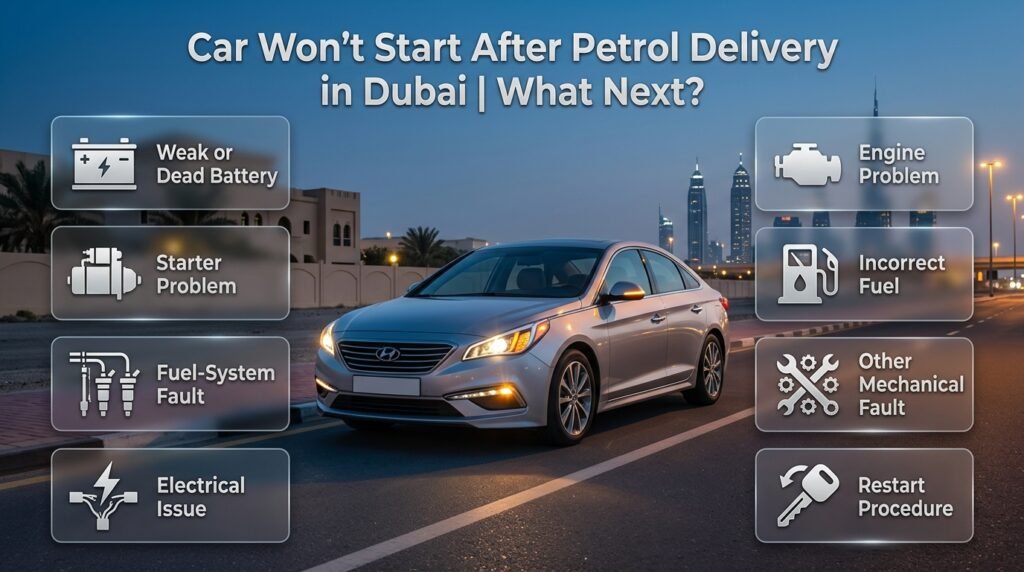
This is an important question because adding petrol doesn’t guarantee that an engine will start.
If the vehicle ran completely dry, it may require an appropriate restart procedure depending on its design.
But there may also be another problem.
Possible causes include:
- Weak or dead battery.
- Starter problem.
- Fuel-system fault.
- Electrical issue.
- Engine problem.
- Incorrect fuel.
- Another mechanical fault.
Signs That Fuel May Not Be the Main Problem
Pay attention if:
- The fuel gauge wasn’t empty.
- The engine stopped suddenly.
- Warning lights appeared before the vehicle stopped.
- The starter doesn’t operate.
- The dashboard behaves unusually.
- The car still won’t start after receiving the correct fuel.
In that situation, don’t simply keep ordering more petrol.
Explain the symptoms and seek suitable roadside or professional assistance.
For urgent situations specifically related to fuel, you can also review Emergency Petrol Delivery Dubai.
Petrol Delivery vs Emergency Petrol Delivery vs Urgent Fuel Delivery
These terms are closely related, but they shouldn’t all be treated as one keyword topic.
Petrol Delivery for Cars
This is the broad topic.
The user wants information about getting petrol delivered to a car, including general use cases, ordering steps, vehicle requirements, and practical considerations.
Emergency Petrol Delivery Dubai
This focuses on a vehicle that has already run out of fuel or is in an immediate fuel-related problem.
For that situation, see Emergency Petrol Delivery Dubai.
Urgent Fuel Delivery Dubai
This has stronger urgency intent.
Drivers searching for this phrase are generally looking for quick assistance rather than general education. The dedicated Urgent Fuel Delivery Dubai resource is therefore more specific.
Fast Petrol Delivery Dubai
This focuses on speed and response.
If response time is the primary concern, Fast Petrol Delivery Dubai is a more focused resource.
Emergency Fuel Near Me
This has a strong local and immediate intent.
Someone searching Emergency Fuel Near Me is usually trying to find assistance based on their current location.
This distinction is important for SEO because each page can satisfy a different search intent instead of every page competing for the same keyword.
How Can You Prepare Before You Run Out of Petrol?
The best fuel emergency is the one you prevent.
Keep an Eye on the Fuel Gauge
Don’t wait until the tank is completely empty.
Understand Your Vehicle’s Fuel Requirements
Know:
- Petrol type.
- Recommended fuel grade.
- Approximate tank capacity.
- Typical fuel consumption.
Know the General Area
If you’re travelling somewhere unfamiliar, understand where major petrol stations are located along your route.
Keep Your Phone Charged
If you need roadside assistance, a working phone is essential.
Know Your Vehicle’s Location
If you stop unexpectedly, identify your road and nearby landmark before calling.
Save Useful Information
Keep important vehicle details accessible so you don’t have to search through documents during a stressful situation.
What Should You Do Immediately After Running Out of Petrol?
If your car has stopped because the tank is empty, use this simple checklist:
Fuel Emergency Checklist
1. Stay calm.
A fuel problem is stressful, but rushing can create additional risks.
2. Make the vehicle safe.
Move it away from active traffic only if this can be done safely.
3. Confirm the fuel problem.
Check the gauge and what happened before the engine stopped.
4. Identify your exact location.
Road + direction + landmark + position.
5. Confirm the fuel type.
Don’t guess.
6. Contact an appropriate service.
Explain exactly what happened.
7. Confirm the total cost.
Avoid misunderstandings.
8. Wait safely.
Stay away from dangerous traffic areas.
9. Test the vehicle after fuelling.
If it doesn’t start, explain the symptoms rather than assuming more petrol is needed.
What Are the Most Important Safety Rules?
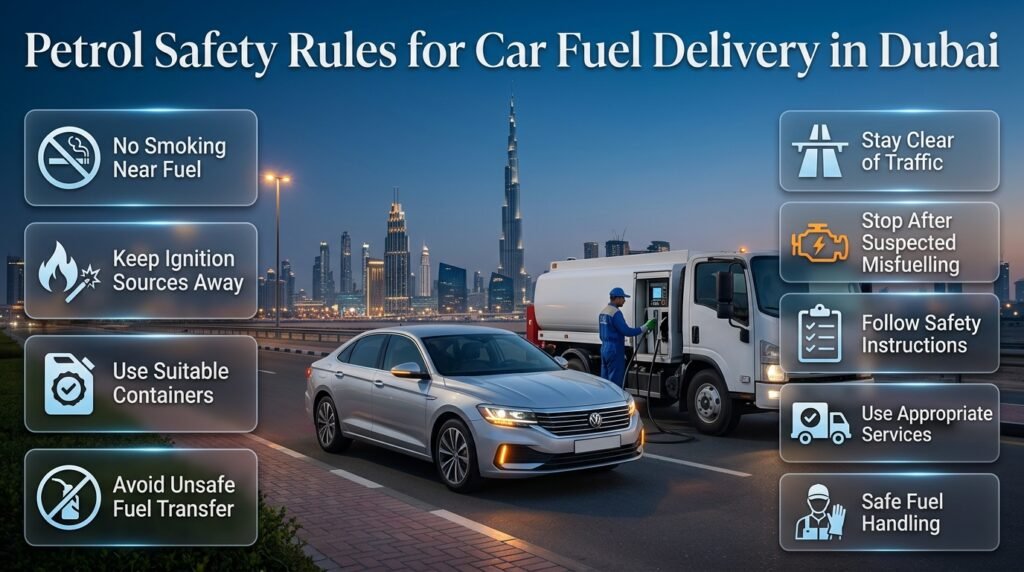
Petrol should always be treated as a flammable substance.
For that reason:
- Don’t smoke around fuel.
- Keep ignition sources away.
- Don’t use damaged or unsuitable containers.
- Don’t attempt unsafe fuel transfer.
- Don’t improvise fuel storage.
- Don’t stand unnecessarily close to moving traffic.
- Don’t continue driving after suspected misfuelling.
- Follow the provider’s safety instructions.
- Use properly authorised services where required.
Dubai’s official requirements specifically address safety, specialised vehicles, fuel transport, closed tanks to prevent leaks, vehicle specifications, and other conditions associated with fuel-delivery activities.
📌 Quick Tip: The professional approach isn’t simply “get petrol as quickly as possible.” It’s get the correct fuel through an appropriate service while keeping people and the vehicle safe.
What If You Put the Wrong Fuel in Your Car?
This is different from simply running out of petrol.
If you have added the wrong fuel, don’t continue driving just because the engine still appears to work.
The correct response depends on the vehicle and the type of misfuelling.
Tell the assistance provider exactly what happened.
For example:
“The car was supposed to receive petrol, but diesel was added.”
That information is far more useful than simply saying:
“My car isn’t working.”
Why This Matters
Continuing to operate a vehicle after incorrect fuelling can potentially increase the problem.
So don’t treat a misfuelling situation as a normal petrol-delivery request.
It requires a different response.
How Do You Know Whether You Need Fuel Delivery or Recovery?
Use the following decision guide.
| Situation | More Appropriate Direction |
|---|---|
| Empty tank, car otherwise normal | Fuel assistance may be suitable |
| Low fuel but car still running | Reach a station safely if practical |
| Empty tank on roadside | Fuel assistance may be useful |
| Dead battery | Battery/roadside assistance |
| Flat tyre | Tyre assistance |
| Engine fault | Mechanical/roadside assistance |
| Wrong fuel added | Misfuelling assistance |
| Accident | Appropriate emergency/recovery assistance |
| Dangerous traffic position | Prioritise safety and emergency support |
This prevents one of the most common mistakes: assuming every vehicle that has stopped needs petrol.
What Should a Professional Petrol Delivery Experience Look Like?
A good service should make the process understandable.
The driver should know:
- What service is being provided.
- What fuel is being supplied.
- What quantity is involved.
- Where the vehicle is located.
- What the expected total cost is.
- What happens after the vehicle receives fuel.
- What to do if the vehicle still doesn’t start.
Clear communication matters because fuel emergencies often happen when drivers are already stressed.
A complicated booking process can make the situation worse.
How Does Petrol Delivery for Cars Work?
Petrol delivery for cars is designed for situations where a vehicle needs fuel but cannot conveniently reach a petrol station. The driver normally provides the exact vehicle location, confirms the required fuel type and quantity, and checks the total service cost before arranging delivery. Once the fuel is supplied, the vehicle can be checked to see whether it starts and operates normally.
The important part is giving accurate information from the beginning. A road name alone may not be enough, particularly in a large area or on a major road. Providing the direction, nearby landmark, parking location, and exact position can make the request much clearer.
Important points to remember:
Confirm the correct petrol type for your car.
Provide the most accurate location possible.
Ask about the total cost before confirming.
Mention your vehicle type and model if required.
If the car still doesn’t start after fuelling, consider another mechanical or electrical problem.
How Much Petrol Should I Order for My Car?
The right amount of petrol depends on why you’re requesting delivery and where you need to go afterward. If the vehicle has completely run out of fuel and your immediate goal is to reach the nearest suitable petrol station, you may not need enough fuel for a complete tank. On the other hand, if you’re in an area where reaching another station will require a longer drive, the practical amount may be different.
Your vehicle’s fuel consumption, tank capacity, traffic conditions, and distance to the next station should all be considered. It’s better to explain your situation to the provider rather than choosing an amount simply because it sounds sufficient.
Before choosing the quantity, consider:
Your vehicle’s approximate fuel consumption.
Distance to the next petrol station.
Current traffic conditions.
Your car’s fuel-tank capacity.
Whether you only need enough fuel to become mobile again.
The quantity the provider can actually supply.
Professional tip: Don’t automatically request a full tank during a fuel problem. The immediate objective may simply be to get the vehicle running safely and reach a proper refuelling location.
Can Petrol Be Delivered Directly to a Car That Has Run Out of Fuel?
Where an appropriate and available fuel-delivery service operates, petrol may be supplied directly to a stranded vehicle rather than requiring the driver to take the car to a petrol station first. This can be particularly useful when the vehicle has completely run out of fuel and cannot move under its own power.
However, drivers shouldn’t assume that every provider can serve every vehicle or location. Service availability, operating conditions, vehicle requirements, fuel type, location access, and applicable regulations can affect whether delivery can be arranged.
When requesting delivery, provide:
Exact location of the vehicle.
Road name and direction, if relevant.
Vehicle type.
Required fuel type.
Approximate quantity required.
Nearby landmark or identifiable location.
Any access restrictions, such as underground parking.
The safest approach is to confirm current availability directly rather than relying on a general claim that a service operates throughout Dubai.
What Should I Do If My Car Runs Out of Petrol While Driving?
If your car runs out of petrol while driving, the first priority should be getting yourself and the vehicle into the safest practical position. If the vehicle can be moved safely away from active traffic, do so. If it cannot be moved, use appropriate warning measures and avoid standing unnecessarily close to moving vehicles.
Once you’re in a safer position, confirm that the vehicle appears to have run out of fuel. Then identify your exact location and provide that information when contacting a suitable fuel-delivery or roadside assistance provider.
A practical checklist is:
Switch on hazard lights where appropriate.
Move the car to a safer position if it can be done safely.
Avoid standing in an active traffic lane.
Identify the road, direction, and nearby landmark.
Confirm the vehicle’s fuel type.
Contact appropriate assistance.
Stay in a safe position while waiting.
If the car doesn’t start after receiving fuel, explain the symptoms and seek further assistance.
⚠ Important: Don’t assume that every vehicle stoppage is caused by an empty fuel tank. If the gauge wasn’t empty or the vehicle stopped suddenly for another reason, the problem could be mechanical, electrical, or battery-related.
Is Petrol Delivery for Cars Better Than Driving to a Petrol Station?
It depends entirely on the situation. If your car is still running and a petrol station is nearby, driving there safely is usually the simpler option. Petrol delivery becomes more practical when the vehicle has already run out of fuel, cannot reach a station, or is positioned somewhere that makes travelling to a station difficult.
The key decision is whether the vehicle can safely reach a petrol station under its own power. If it can, normal refuelling may be more straightforward. If it cannot because the tank is empty, fuel delivery may provide a practical alternative when a suitable service is available.
Use this simple comparison:
Situation
More Practical Option
Car is still running and station is nearby
Petrol station
Car has completely run out
Petrol delivery may be suitable
Car is safely parked at home
Depends on convenience
Vehicle has a dead battery
Battery/roadside assistance
Engine has another mechanical fault
Professional roadside assistance
Car is stopped in dangerous traffic
Safety and appropriate roadside assistance first
Professional recommendation: Don’t choose petrol delivery simply because it sounds more convenient. First identify the actual problem. If the problem is only lack of fuel, delivery can make sense; if the vehicle has another fault, a different type of assistance may be the better solution.
Conclusion
Running out of petrol can turn a normal drive into a stressful situation, especially when you are stuck in traffic, parked far from a petrol station, or unable to move your car safely. Petrol delivery for cars provides a practical option in these situations by bringing the required fuel to the vehicle instead of requiring the driver to reach a station.
The most important step is to treat fuel delivery as a solution to a specific situation rather than simply ordering the maximum amount available. Drivers should confirm the vehicle’s fuel requirement, provide an accurate location, check that the service is suitable for their car, and understand the total cost before requesting assistance. If the vehicle stopped for a reason other than an empty tank, adding petrol alone may not solve the problem.
Safety should also remain the priority. A car that has stopped on a busy road, highway, or unsafe location should be handled carefully, and drivers should avoid standing in active traffic areas while waiting for assistance. Where possible, the vehicle should be moved to a safer position and its exact location should be communicated clearly.
For drivers who regularly travel around Dubai, understanding the difference between normal petrol delivery, urgent fuel assistance, emergency delivery, and finding a nearby petrol station can also make it easier to choose the right solution. The best option depends on the situation, location, vehicle, availability, and how quickly fuel is actually needed.
Ultimately, petrol delivery for cars is most useful when it solves a genuine fuel-related problem conveniently and safely. By checking the service details beforehand and making sensible decisions during a fuel emergency, drivers can reduce unnecessary delays and get back on the road with greater confidence.
Leave a Reply